FRBM ( Fiscal Responsibility and Budget Management) Act, 2003
The main purpose of this Act is to reduce government borrowing, improve fiscal management, and ensure sustainable economic growth. The Act sets targets for the government to maintain fiscal discipline by limiting deficits and debt levels.
Introduction
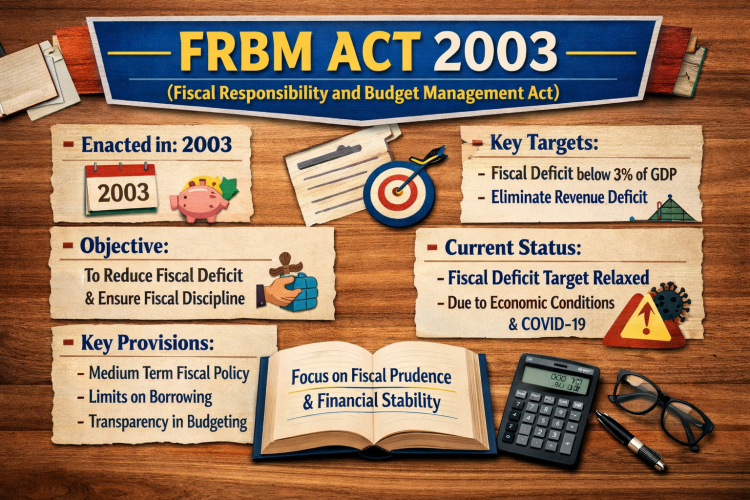
The Fiscal Responsibility and Budget Management (FRBM) Act, 2003 was introduced by the Government of India to ensure financial discipline, transparency, and long-term macroeconomic stability in the country.
Before the FRBM Act, the Indian government was facing large fiscal deficits and rising public debt, which created pressure on the economy and inflation. To control this situation, the government enacted the FRBM Act in August 2003, and it came into effect in July 2004.
Meaning of FRBM Act
The FRBM Act (Fiscal Responsibility and Budget Management Act) is a law enacted by the Government of India to control fiscal deficit, reduce public debt, and promote responsible financial management.
In simple words:
The FRBM Act ensures that the government spends within its means and avoids excessive borrowing, maintaining stability in the economy.
It also requires the government to present regular fiscal reports and maintain transparency in budgetary policies.
Objectives of the FRBM Act
The FRBM Act was created with several important objectives to strengthen India's economic system.
1. Fiscal Discipline
The Act aims to ensure that the government follows responsible financial policies and avoids unnecessary expenditure.
2. Reduce Fiscal Deficit
One of the main objectives is to reduce the fiscal deficit to sustainable levels and maintain macroeconomic stability.
3. Eliminate Revenue Deficit
The Act aims to reduce and eventually eliminate revenue deficit, meaning government borrowing should not be used for daily expenses.
4. Improve Transparency in Fiscal Policy
The FRBM Act requires the government to regularly disclose fiscal information to the public and Parliament.
5. Reduce Public Debt
Another objective is to control the rising public debt and maintain a healthy debt-GDP ratio.
6. Promote Long-Term Economic Stability
By ensuring disciplined fiscal management, the Act supports stable and sustainable economic growth.
7. Improve Investor Confidence
Stable fiscal policies help increase investor confidence in the Indian economy, encouraging domestic and foreign investments.
Key Provisions of the FRBM Act
The FRBM Act includes several provisions that guide the government in maintaining fiscal responsibility.
1. Fiscal Deficit Target
The Act sets a target to keep the fiscal deficit below 3% of GDP to ensure economic stability.
Fiscal deficit means the difference between government expenditure and government revenue (excluding borrowings).
2. Revenue Deficit Reduction
The Act originally aimed to eliminate revenue deficit, ensuring that borrowings are used mainly for capital investments rather than routine expenses.
3. Borrowing Restrictions
The government is restricted from borrowing excessively from the Reserve Bank of India (RBI), preventing inflationary financing.
4. Fiscal Policy Statements
The government must present the following reports in Parliament along with the Union Budget:
• Medium-Term Fiscal Policy Statement
• Fiscal Policy Strategy Statement
• Macroeconomic Framework Statement
These reports explain fiscal targets and government strategies.
5. Transparency and Accountability
The Act ensures that the government provides clear and transparent fiscal data regarding revenues, expenditures, and borrowings.
6. Escape Clause
In exceptional situations such as national security threats, natural disasters, pandemics, or severe economic downturns, the government can temporarily deviate from fiscal targets.
This provision was used during the COVID-19 pandemic.
Recent Fiscal Data (Previous Years)
Due to global economic challenges and the COVID-19 pandemic, India temporarily relaxed the FRBM targets.
Fiscal Deficit Data (India)
| Year | Fiscal Deficit (% of GDP) |
|---|---|
| 2019-20 | 4.6% |
| 2020-21 | 9.2% (COVID-19 impact) |
| 2021-22 | 6.7% |
| 2022-23 | 6.4% |
| 2023-24 | 5.8% |
| 2024-25 (Target) | 5.1% |
The government aims to gradually reduce the fiscal deficit to below 4.5% by 2025-26.
Challenges of the FRBM Act
Despite its benefits, the Act faces several challenges:
• Economic crises force the government to relax fiscal targets.
• High welfare spending increases fiscal pressure.
• Global economic shocks affect government revenue.
• Infrastructure and development projects require large investments.
Conclusion
The FRBM Act, 2003 is an important framework for maintaining fiscal discipline and economic stability in India. It helps control government borrowing, improve transparency, and ensure responsible financial management.
Although economic crises sometimes require temporary relaxation of fiscal targets, the FRBM Act continues to guide India toward sustainable fiscal policies and long-term economic growth.
What's Your Reaction?