1. Introduction
In today’s global economy, countries are closely connected through trade, investment, tourism, and financial flows. The Balance of Payments (BOP) is an important economic record that tracks all economic transactions between a country and the rest of the world during a specific period, usually a year.
These transactions include exports and imports of goods and services, foreign investments, remittances, and financial transfers. The BOP helps economists and governments understand whether a country is earning more foreign currency than it spends or vice versa.
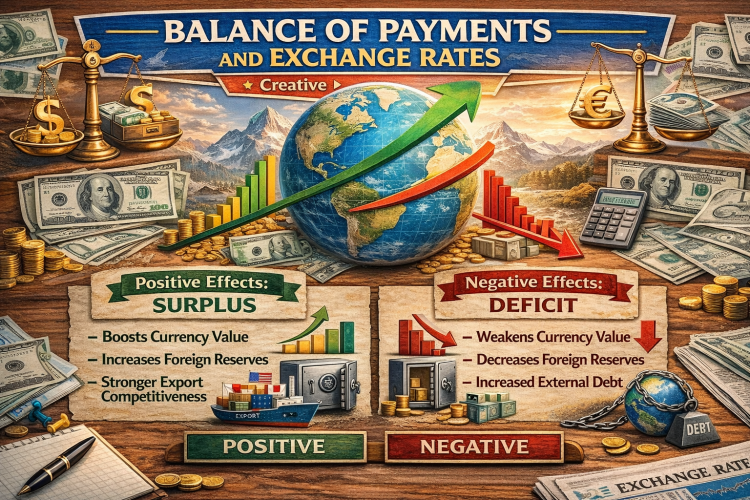
Closely related to the BOP is the exchange rate, which determines the value of one country's currency in terms of another. Exchange rates influence international trade because they affect the price of exports and imports. If a country has a persistent deficit in its BOP, it may put pressure on its currency, causing depreciation. On the other hand, a surplus can strengthen the currency.
For policymakers, the BOP acts as a financial report card of a nation’s international economic performance. It provides insights into economic stability, trade competitiveness, and global financial relationships.
2. Meaning of Balance of PaymentsÂ
The Balance of Payments (BOP) refers to the systematic record of all economic transactions between residents of a country and the rest of the world during a given period.
According to economists, the BOP includes three main components:
-
Current Account
-
Records trade in goods and services.
-
Includes exports, imports, remittances, and income from abroad.
-
Capital Account
-
Financial Account
In theory, the BOP should always balance because every international transaction involves both a credit and a debit entry. However, countries may experience deficits or surpluses in specific accounts, particularly the current account.
3. Previous Year Deficit Comparison (India Example)Â
| Year |
Current Account Deficit (% of GDP) |
Major Reasons |
| 2022 |
2.0% |
High oil import bill and global supply disruptions |
| 2023 |
1.2% |
Increase in service exports and remittances |
| 2024 |
1.0% |
Stable imports and strong IT sector earnings |
| 2025 |
1.1% |
Rising imports of electronics and crude oil |
Observation:
India’s deficit has fluctuated mainly due to oil prices, global demand, and service exports like IT and business outsourcing.
4. Important Facts about Balance of Payments
-
Indicator of Economic Strength
The BOP reflects a country's economic performance in international markets.
-
Exchange Rate Influence
Persistent deficits may lead to currency depreciation, while surpluses can strengthen the currency.
-
Role of Services
Countries like India reduce trade deficits through strong service exports such as IT and business services.
-
Foreign Investment Impact
Foreign Direct Investment (FDI) and portfolio investments help finance deficits in the current account.
-
Policy Tool
Governments and central banks monitor BOP data to adjust monetary policy, trade policy, and exchange rate management.
-
Remittances Contribution
India receives one of the largest amounts of remittances from overseas workers, which supports the current account.
5. Historical Background of Balance of PaymentsÂ
The concept of the Balance of Payments has evolved alongside international trade.
-
18th–19th Century:
Economists used the BOP concept to analyze trade flows during the period of mercantilism and colonial trade.
-
Post-World War II Era:
After the establishment of the International Monetary Fund (IMF) in 1944, a standardized system for recording BOP statistics was developed. Countries began reporting detailed BOP data to maintain global financial stability.
-
Bretton Woods System (1944–1971):
Exchange rates were fixed against the US dollar, and the BOP was closely monitored to maintain currency stability.
-
Modern Era:
With globalization and floating exchange rates, the BOP now includes complex financial flows such as portfolio investment, multinational corporate activities, and digital service exports.
Today, BOP statistics are essential for economic planning, international comparisons, and global financial cooperation.
Conclusion:
The Balance of Payments plays a crucial role in understanding a country's economic interaction with the rest of the world. It helps policymakers evaluate trade performance, capital flows, and currency stability. Exchange rates are closely linked with the BOP because they influence international trade and financial movements. A well-managed BOP ensures economic stability and sustainable growth in the global economy.