Role of Policy and Infrastructure in Facilitating Technology Transfer in LDCs
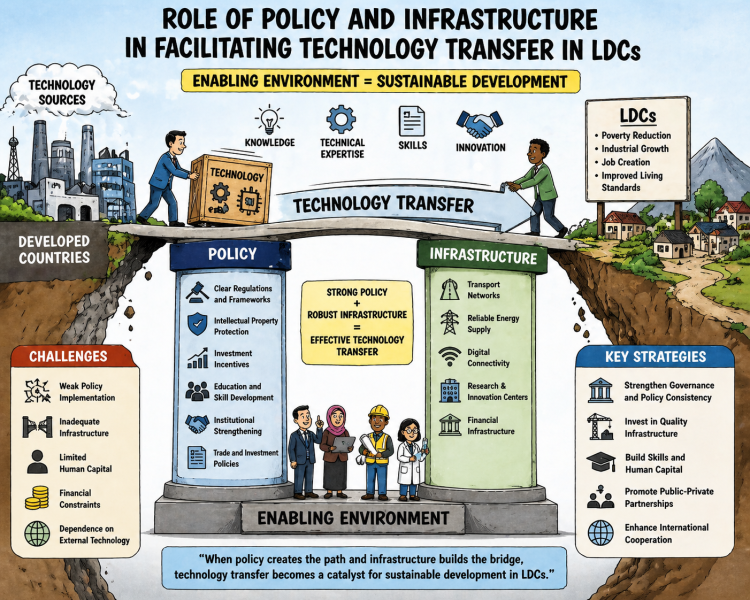
This study explores the crucial role of policy frameworks and infrastructure in enabling effective technology transfer in Least Developed Countries (LDCs). Technology transfer is essential for bridging the development gap by enhancing productivity, innovation, and industrial growth. However, its success depends on the presence of a supportive environment shaped by strong government policies and well-developed infrastructure systems. The paper highlights how policies related to investment, education, intellectual property rights, and institutional governance create a favorable climate for technology adoption. At the same time, it emphasizes the importance of physical, digital, financial, and innovation infrastructure in facilitating the smooth transfer and utilization of technology.
Introduction
Technology transfer is a critical driver of economic development, innovation, and industrial growth, particularly in Least Developed Countries (LDCs). These nations often face structural challenges such as limited industrial capacity, weak institutional frameworks, and inadequate infrastructure. As a result, access to modern technology becomes essential for improving productivity, competitiveness, and overall socio-economic conditions.
Technology transfer refers to the process through which knowledge, skills, innovations, and technologies are shared between countries, institutions, or organizations. For LDCs, this process is vital in bridging the technological gap with developed economies. However, successful technology transfer does not occur automatically; it depends heavily on supportive policies and strong infrastructure systems.
This study examines how policy frameworks and infrastructure development play a crucial role in facilitating effective technology transfer in LDCs.
Understanding Technology Transfer in LDCs
Technology transfer involves more than just importing machinery or equipment. It includes:
- Transfer of knowledge and technical expertise
- Adoption of new production processes
- Development of human capital
- Institutional learning and innovation
For LDCs, technology transfer can occur through various channels such as:
- Foreign Direct Investment (FDI)
- International trade
- Joint ventures and partnerships
- Educational and research collaborations
Despite these channels, many LDCs struggle to fully benefit from technology transfer due to weak policy environments and inadequate infrastructure.
Importance of Policy in Technology Transfer
1. Creating a Supportive Regulatory Environment
Government policies play a central role in creating an environment conducive to technology transfer. Clear and transparent regulations encourage foreign investors and technology providers to engage with LDCs.
Policies related to:
- Trade liberalization
- Investment protection
- Intellectual property rights
help build trust and reduce risks for international partners.
For instance, strong intellectual property laws ensure that innovators feel secure sharing their technologies, while flexible regulations can promote adaptation and local innovation.
2. Investment and Industrial Policies
Strategic industrial policies can guide technology transfer toward priority sectors such as agriculture, manufacturing, and renewable energy.
Governments can:
- Provide tax incentives for technology-intensive investments
- Establish special economic zones
- Support local industries through subsidies and grants
These measures attract foreign firms and encourage domestic firms to adopt new technologies.
3. Education and Skill Development Policies
Human capital is a key component of technology transfer. Without skilled workers, imported technologies cannot be effectively utilized.
Policies focused on:
- Technical education
- Vocational training
- Research and development
help build a workforce capable of absorbing and adapting new technologies.
4. Institutional Strengthening
Strong institutions are essential for implementing policies and managing technology transfer processes. This includes:
- Efficient government agencies
- Transparent legal systems
- Anti-corruption measures
Institutional capacity ensures that policies are effectively enforced and that resources are properly utilized.
Role of Infrastructure in Technology Transfer
1. Physical Infrastructure
Physical infrastructure forms the backbone of economic activity and technology adoption. Key components include:
- Transportation networks (roads, ports, railways)
- Energy supply (electricity, renewable energy)
- Industrial facilities
Reliable infrastructure reduces operational costs and enables the smooth movement of goods, services, and technologies.
For example, poor electricity supply can hinder the operation of advanced machinery, limiting the benefits of technology transfer.
2. Digital Infrastructure
In the modern era, digital infrastructure is equally important. Access to:
- High-speed internet
- Telecommunications networks
- Data systems
facilitates knowledge sharing, remote collaboration, and access to global markets.
Digital platforms enable LDCs to participate in global value chains and benefit from technological advancements.
3. Innovation Infrastructure
Innovation ecosystems support the development and adaptation of new technologies. These include:
- Research institutions
- Universities
- Technology parks
- Incubators and startups
Such infrastructure fosters collaboration between academia, industry, and government, promoting innovation and knowledge transfer.
4. Financial Infrastructure
Access to finance is crucial for adopting new technologies. Financial infrastructure includes:
- Banks and credit institutions
- Venture capital and investment funds
- Microfinance systems
Without adequate financing, firms in LDCs may struggle to invest in new technologies or upgrade existing systems.
What's Your Reaction?