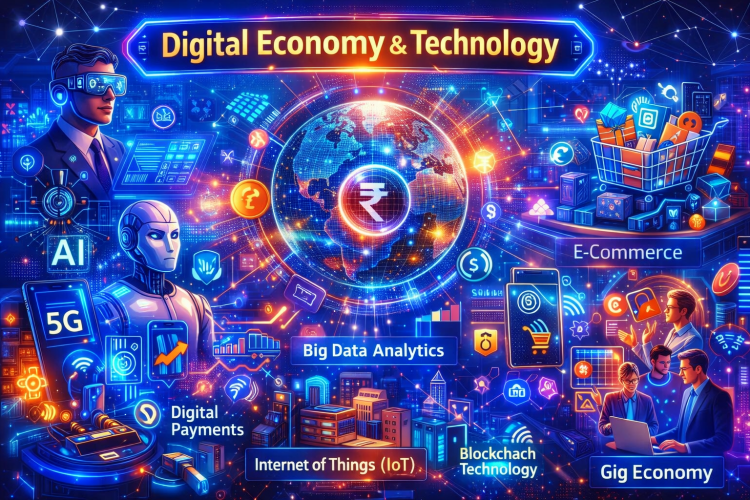
Digital Economy and Technology
The digital economy refers to an economy that is primarily based on digital technologies, including the internet, mobile devices, cloud computing, and data analytics. It encompasses all economic activities that rely on digital platforms, online transactions, and information technology.
Introduction
The digital economy refers to an economy that is primarily based on digital technologies, including the internet, mobile devices, cloud computing, and data analytics. It encompasses all economic activities that rely on digital platforms, online transactions, and information technology. Over the past two decades, the digital economy has transformed the way businesses operate, governments function, and individuals interact. Technology has become the backbone of modern economic systems, enabling faster communication, improved productivity, and global connectivity.
Meaning and Concept of Digital Economy
The digital economy includes all activities that involve digitalized information and knowledge as key factors of production. It goes beyond traditional sectors and includes e-commerce, online banking, digital payments, fintech, and digital services. Unlike the traditional economy, which depends on physical resources, the digital economy relies heavily on data, software, and networks.
It can be divided into three main components:
- Core Digital Sector – IT/ITES companies, software development, telecommunications
- Platform Economy – Online platforms like Amazon, Google, and Meta Platforms
- Digitally Enabled Economy – Businesses that use digital tools to improve operations
Evolution of Digital Economy
The digital economy evolved with the development of the internet in the 1990s. Initially, it focused on basic communication and information sharing. With the rise of smartphones, cloud computing, and high-speed internet, it expanded rapidly. Today, technologies like Artificial Intelligence (AI), Blockchain, and the Internet of Things (IoT) are driving the next phase of digital transformation.
In India, initiatives like Digital India, UPI payments, and widespread smartphone usage have accelerated the growth of the digital economy.
Role of Technology in Digital Economy
Technology plays a central role in shaping the digital economy. It acts as both an enabler and driver of economic activities.
- Internet and Connectivity: Enables global communication and online transactions
- Cloud Computing: Allows businesses to store and access data remotely
- Artificial Intelligence (AI): Automates processes and improves decision-making
- Big Data Analytics: Helps in analyzing large volumes of data for better insights
- Blockchain Technology: Ensures transparency and security in transactions
Components of Digital Economy
| E-Commerce | E-commerce refers to buying and selling goods and services online. Platforms like Flipkart and Amazon have revolutionized retail by providing convenience, variety, and competitive pricing. |
| Digital Payments | Digital payment systems such as UPI, mobile wallets, and online banking have reduced dependency on cash. India is one of the leading countries in digital transactions due to platforms like National Payments Corporation of India. |
| FinTech | Financial technology combines finance and technology to provide innovative financial services such as digital lending, robo-advisors, and cryptocurrency. |
| Gig Economy | Digital platforms have created new job opportunities such as freelancing, ride-sharing, and food delivery services. |
| Digital Services | ncludes online education, telemedicine, streaming services, and cloud-based software solutions. |
What's Your Reaction?