Monetary Policy of India
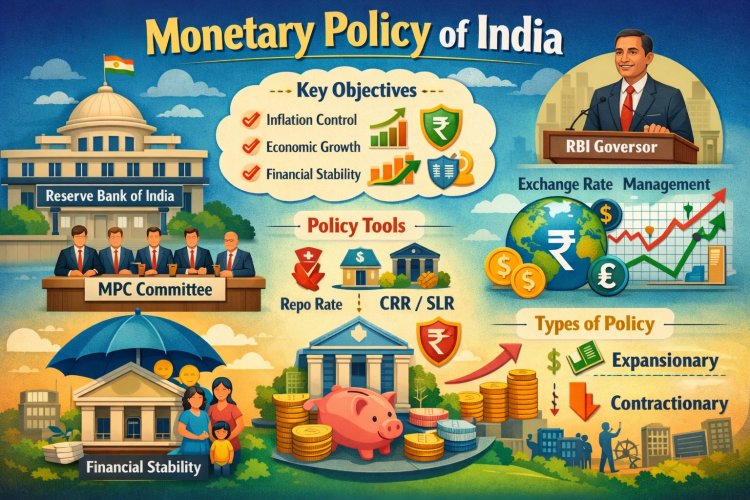
Monetary policy is one of the most important tools used by a country to manage its economy. It refers to the policy adopted by a nation’s central bank to control the supply of money and credit in the economy in order to achieve macroeconomic stability.
MONETARY POLICY
India, monetary policy is formulated and implemented by the Reserve Bank of India (RBI). The RBI regulates interest rates, controls inflation, ensures financial stability, and promotes economic growth through various monetary tools.
In simple terms, monetary policy means managing the availability and cost of money in the economy. When there is too much money in circulation, it can lead to inflation, and when there is too little money, it can slow down economic growth.
Therefore, the central bank carefully adjusts monetary conditions to maintain balance.
Objectives of Monetary Policy
The primary objectives of monetary policy in India are:
- Price Stability (Inflation Control):
The RBI aims to maintain inflation at a moderate level. As per the current framework, the inflation target is 4% with a tolerance band of 2%. This ensures that prices do not rise too rapidly, protecting purchasing power. - Economic Growth:
Monetary policy supports sustainable economic growth by ensuring adequate flow of credit to productive sectors like agriculture, industry, and services. - Financial Stability:
The RBI ensures stability in the financial system by regulating banks and controlling liquidity to prevent crises. - Exchange Rate Stability:
It also aims to reduce excessive volatility in the value of the Indian Rupee in international markets. - Employment Generation:
By promoting investment and growth, monetary policy indirectly helps in creating employment opportunities.
Monetary Policy Framework in India
The modern monetary policy framework in India is based on Inflation Targeting. This framework was formally adopted after the amendment of the Reserve Bank of India Act, 1934 in 2016.
The MPC consists of 6 members:
- 3 members from RBI (including the Governor)
- 3 external members appointed by the government
The committee meets regularly (at least 4 times a year) to review economic conditions and decide policy rates.
INSTURMENTS OF MONETORY POLICY
1. Quantitative Instruments
These tools directly affect the money supply and credit in the economy.
a) Repo Rate
The rate at which RBI lends money to commercial banks for short-term needs.
- Increase in repo rate → borrowing becomes expensive → reduces money supply
- Decrease in repo rate → borrowing becomes cheaper → increases money supply
b) Reverse Repo Rate
The rate at which RBI borrows money from commercial banks.
- Higher reverse repo → banks park more funds with RBI → reduces liquidity
c) Cash Reserve Ratio (CRR)
The percentage of total deposits that banks must keep with RBI in cash form.
- Higher CRR → less money available for lending
- Lower CRR → more money available for lending
d) Statutory Liquidity Ratio (SLR)
The percentage of deposits that banks must maintain in liquid assets like gold or government securities.
e) Bank Rate
The long-term rate at which RBI lends to commercial banks. It influences other interest rates in the economy.
f) Open Market Operations (OMO)
RBI buys or sells government securities in the open market:
- Buying securities → increases money supply
- Selling securities → reduces money supply
Qualitative Instruments of Monetary Policy (India)
Qualitative instruments—also called selective credit controls—are tools used by the Reserve Bank of India (RBI) to control not just how much credit is available, but where it flows in the economy. Instead of changing total money supply like repo rate or CRR, these tools guide banks to lend in specific directions, ensuring that priority sectors get support while risky or speculative activities are restrained.
Key Qualitative Instruments
1. Selective Credit Control (SCC)
This is one of the most important qualitative tools.
- RBI directs banks to restrict or expand credit for specific sectors.
- Often used to control speculation in essential commodities like food grains, sugar, or oil.
- Helps prevent artificial price rise (inflation) due to hoarding.
Example:
If traders start hoarding wheat to raise prices, RBI may restrict loans for such activities.
2. Credit Rationing
Under this method, RBI limits the total amount of credit that banks can give.
- Sets a ceiling on loans for certain sectors or borrowers
- Ensures fair distribution of credit
- Prevents over-lending to non-essential or risky sectors
Purpose:
To ensure priority sectors like agriculture and MSMEs get sufficient funds.
3. Moral Suasion
This is a soft and informal method.
- RBI advises and persuades banks to follow certain policies
- No legal force, but banks usually comply due to RBI’s authority
Example:
RBI may request banks to reduce lending for luxury imports or increase lending to small businesses.
 Think of it as “guidance with influence,†not compulsion.
4. Margin Requirements
This tool controls the loan amount against collateral.
- Margin = Difference between value of asset and loan given
- Higher margin → lower loan → less speculation
- Lower margin → higher loan → more credit availability
Example:
If margin on gold loans is increased, people can borrow less against gold → reduces excess borrowing.
5. Direct Action
This is a stricter measure.
- RBI can take action against banks that do not follow its guidelines
- Includes penalties, restrictions, or refusal of financial support
Example:
A bank ignoring RBI rules may be denied refinance facilities.
6. Priority Sector Lending (PSL) Guidelines
RBI ensures banks lend to important sectors.
- Agriculture
- MSMEsÂ
- EducationÂ
- HousingÂ
Banks are required to allocate a fixed percentage of loans to these sectors.
Impact:
Promotes inclusive growth and reduces inequality.
7. Consumer Credit Regulation
Used to control credit for consumer goods.
- RBI may regulate installment terms, down payments, or loan duration
- Helps control excessive consumer spending during inflation
Example:
Tightening rules on car loans to reduce demand and inflation.
Role of RBI in Monetary Policy (India)
The Reserve Bank of India (RBI) is the central authority responsible for designing and implementing monetary policy in India. Its role is not just limited to setting interest rates—it actively manages inflation, liquidity, financial stability, and overall economic growth. Let’s explore its role in detail.
1. Formulation of Monetary Policy
The RBI formulates monetary policy through the Monetary Policy Committee (MPC).
- The MPC consists of 6 members (3 from RBI + 3 external experts).
- It meets regularly to decide the policy repo rate and stance (accommodative, neutral, tightening).
- Decisions are based on data like inflation, GDP growth, global trends, and liquidity conditions.
2. Controlling Inflation (Price Stability)
One of RBI’s primary roles is to maintain price stability.
- India follows an inflation targeting framework (4% ± 2%).
- RBI increases interest rates when inflation is high.
- RBI reduces rates when inflation is low or growth slows.
3. Regulation of Money Supply
RBI controls the supply of money and credit in the economy using various tools:
- Repo Rate & Reverse Repo Rate
- Cash Reserve Ratio (CRR)
- Statutory Liquidity Ratio (SLR)
- Open Market Operations (OMO)
4. Maintaining Financial Stability
RBI safeguards the financial system by:
- Regulating banks and NBFCs
- Monitoring risks in the financial sector
- Preventing financial crises
What's Your Reaction?