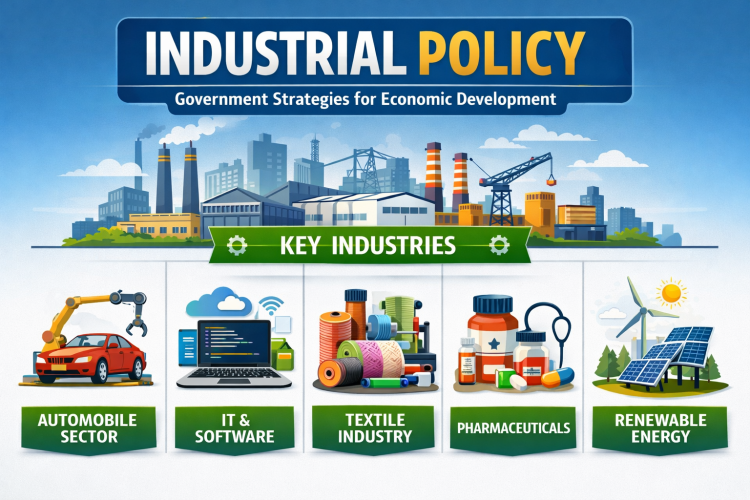
Industrial Policy refers to the strategy and actions taken by a government to regulate, promote, and guide the growth of industries in an economy. It includes decisions related to investment, production, infrastructure, technology, and the role of public and private sectors. The main aim of industrial policy is to achieve economic growth, generate employment, ensure balanced regional development, and improve productivity. In countries like India, industrial policy has evolved from strict government control to liberalization and encouragement of private participation after 1991, helping industries become more competitive and globally integrated.
The Industrial Policy Resolution of 1948

- First comprehensive industrial policy announced after independence. At that time, India faced the challenge of rebuilding its economy, which had been weakened during colonial rule. The 1948 policy aimed to establish a mixed economic system where both the public and private sectors would play important roles.Â
- It categorized industries into four groups: industries exclusively owned and managed by the state, industries where the state and private sector would jointly participate, industries left to the private sector but subject to government control, and small-scale and cottage industries that were encouraged for rural development.
- The policy also emphasized the importance of regulating industries through licensing, ensuring balanced regional development, and preventing the concentration of economic power. Although it allowed private enterprise, the government retained significant control over key sectors, laying the foundation for a planned economic system.
The Industrial Policy Resolution of 1956
 Â
Â
The role of the public sector and is often regarded as the cornerstone of India’s socialist-oriented industrial development. This policy was introduced during a period when the government aimed to accelerate industrialization and achieve self-reliance.
 It expanded the scope of the public sector and classified industries into three categories known as Schedule A, Schedule B, and Schedule C.
 Schedule A industries, such as defense production, atomic energy, and railways, were exclusively reserved for the state.
 Schedule B industries were primarily under state control, but private participation was allowed gradually.
 Schedule C industries were left to the private sector, though they were still regulated through licensing.Â
The 1956 policy emphasized heavy industries, capital goods industries, and infrastructure development, which were considered essential for long-term economic growth. It also focused on reducing regional inequalities, promoting small-scale industries, and preventing monopolies.
However, the extensive system of industrial licensing, often referred to as the “License Raj,†led to bureaucratic delays, inefficiencies, and limited competition over time.
By the late 1980s,

It became evident that the existing industrial policies were not delivering the desired results. The Indian Economy faced several challenges, including low productivity, lack of competitiveness, high fiscal deficits, and a severe balance of payments crisis.
In response, the government introduced the New Industrial Policy in 1991, marking a significant shift from state control to market-oriented reforms. This policy was based on the principles of Liberalization, Privatization, and Globalization (LPG). Liberalization involved reducing government controls, abolishing industrial licensing for most industries, and allowing market forces to determine production and pricing.
Privatization aimed at reducing the role of the public sector by disinvesting government ownership in state-owned enterprises and encouraging private sector participation. Globalization focused on integrating the Indian economy with the global market by promoting exports, encouraging foreign direct investment (FDI), and reducing trade barriers.
The 1991 policy

 It brought several important reforms Such as:-
- Industrial licensing was abolished for most industries except a few related to security and environmental concerns. The public sector was reduced to a limited number of strategic industries, and many sectors were opened up to private and foreign investors.
- The policy also introduced measures to promote competition, improve efficiency, and encourage technological advancement. As a result, Indian industries became more dynamic, competitive, and globally connected. Sectors such as information technology, telecommunications, and automobiles witnessed rapid growth, contributing significantly to economic development.
In conclusion
The three industrial policies represent different phases of India’s economic journey. The 1948 policy laid the foundation of a mixed economy, the 1956 policy strengthened state control and emphasized heavy industrialization, and the 1991 policy transformed the economy through liberalization and globalization. Together, these policies have played a crucial role in shaping India’s industrial structure, promoting economic growth, and adapting to changing global economic conditions.