Impact of Safeguard Investigations on India’s Chemical Industry: A Case of Soda Ash
India’s chemical industry plays a vital role in the country’s economic development, contributing significantly to GDP, employment, and industrial output. It is one of the largest sectors in India, accounting for around 7% of GDP and employing millions of people.
Introduction
Within this sector, soda ash (sodium carbonate) is an essential inorganic chemical used in industries such as glass manufacturing, detergents, chemicals, and textiles. Due to its wide industrial applications, fluctuations in its supply and pricing can have ripple effects across the economy.
In March–April 2026, India initiated a safeguard investigation into soda ash imports, marking a crucial development in trade policy. This study examines the impact of such safeguard investigations on India’s chemical industry, focusing on soda ash as a case example.
➡️Understanding Safeguard Investigations
A safeguard investigation is a trade remedy measure used when a surge in imports threatens or causes serious injury to domestic industries. Unlike anti-dumping duties, safeguard measures do not require proof of unfair pricing; instead, they focus on the volume and impact of imports.
In India, such investigations are conducted by the Directorate General of Trade Remedies (DGTR). If the investigation concludes that domestic producers are being harmed, the government may impose quantitative restrictions, tariffs, or other protective measures.
Safeguards have become an important policy tool globally and in India, especially in sectors facing intense international competition
➡️ Background of the Soda Ash Investigation
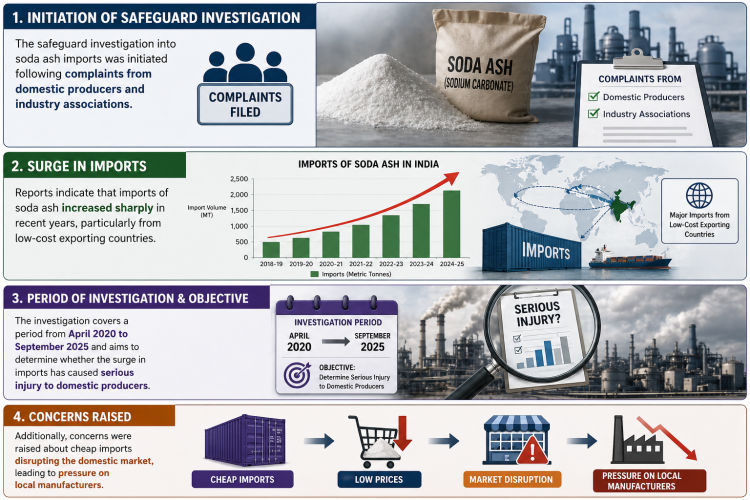
The safeguard investigation into soda ash imports was initiated following complaints from domestic producers and industry associations. Reports indicate that imports of soda ash increased sharply in recent years, particularly from low-cost exporting countries.
The investigation covers a period from April 2020 to September 2025 and aims to determine whether the surge in imports has caused serious injury to domestic producers.
Additionally, concerns were raised about cheap imports disrupting the domestic market, leading to pressure on local manufacturers.
➡️Positive Impacts of Safeguard Investigations
1. Protection of Domestic Industry
The primary benefit of safeguard investigations is the protection of domestic manufacturers from sudden import surges. When cheap imports flood the market, local producers struggle to compete, leading to reduced production, profits, and employment.
Safeguard measures can:
- Stabilize domestic prices
- Prevent factory shutdowns
- Protect jobs
For soda ash producers, this could ensure long-term sustainability and encourage domestic production.
2. Encouragement of Domestic Investment
When industries feel protected from unfair competition, they are more likely to invest in:
- Capacity expansion
- Technological upgrades
- Research and development
In the case of soda ash, companies may increase production capabilities, strengthening India’s self-reliance in chemicals.
3. Strategic Industrial Growth
Safeguards align with India’s broader goals such as “Make in India” and reducing import dependency. By supporting domestic industries, the government ensures:
- Industrial growth
- Supply chain resilience
- Reduced reliance on foreign suppliers
This is particularly important in essential sectors like chemicals.
4. Market Stability
A sudden influx of cheap imports can distort markets. Safeguards help maintain:
- Fair competition
- Predictable pricing
- Stable supply conditions
This benefits both producers and long-term industrial planning.
➡️Negative Impacts of Safeguard Investigations
1. Increased Costs for Downstream Industries
While safeguards protect producers, they can raise prices for industries that use soda ash as a raw material, such as:
- Glass manufacturers
- Detergent producers
Higher input costs may reduce competitiveness of downstream industries, especially in export markets.
2. Risk of Trade Retaliation
Safeguard measures can lead to tensions with exporting countries. Trading partners may:
- Challenge measures at the WTO
- Impose retaliatory tariffs
This could affect India’s broader trade relations.
3. Reduced Import Competition
While reducing imports helps domestic firms, it may also:
- Lower competitive pressure
- Reduce efficiency improvements
Without competition, domestic firms may become less innovative or cost-efficient.
4. Short-Term Nature of Relief
Safeguards are temporary measures. If domestic industries do not improve competitiveness during this period, they may face challenges again once protections are removed.
➡️Impact on the Overall Chemical Industry
The soda ash safeguard investigation reflects broader trends in India’s chemical sector:
1. Rising Use of Trade Remedies
India increasingly relies on trade remedies such as anti-dumping and safeguards to protect industries. This indicates growing concerns about global competition and import dependency.
2. Strengthening of Core Chemical Segments
By protecting basic chemicals like soda ash, India strengthens the foundation of its chemical industry. This supports downstream sectors and promotes industrial growth.
3. Policy Shift Toward Self-Reliance
The investigation highlights India’s shift toward economic self-reliance, focusing on domestic production rather than imports.
4. Balancing Protection and Competitiveness
The key challenge for policymakers is to balance:
- Protection of domestic industries
- Maintaining competitiveness of downstream sectors
This balance is crucial for sustainable industrial growth.
➡️Conclusion
The safeguard investigation into soda ash imports represents a significant step in India’s trade and industrial policy. It highlights the challenges faced by domestic industries in a globalized economy and the need for strategic interventions.
While safeguard measures offer immediate relief to domestic producers, their long-term success depends on how effectively industries utilize this protection to enhance competitiveness. At the same time, policymakers must ensure that such measures do not adversely affect downstream industries or international trade relations.
Overall, the soda ash case demonstrates that safeguard investigations are a double-edged sword—providing protection and stability on one side, while posing risks of inefficiency and trade tensions on the other. A balanced and strategic approach is essential for ensuring sustainable growth of India’s chemical industry.
What's Your Reaction?