Forms of business organisations and Comparative Study
In ancient times, most businesses were carried out by individuals or families on a small scale. As trade expanded during the Industrial Revolution (18th and 19th centuries), businesses required more capital, better management, and shared responsibilities. This led to the development of new forms of business organisations such as partnerships, cooperative societies, and companies. Today, businesses operate in various forms depending on their size, objectives, legal requirements, and financial needs.
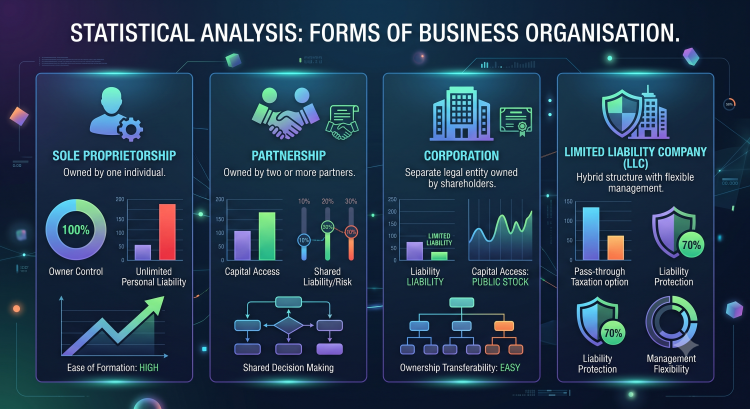
Introduction: Forms of Business Organisation
Business is an essential part of every economy, as it produces goods and services, creates employment, and contributes to economic growth. To conduct business efficiently, different forms of business organisation have evolved over time. A business organisation refers to the legal and structural framework under which a business is owned, managed, and operated.
Brief History
In ancient times, most businesses were carried out by individuals or families on a small scale. As trade expanded during the Industrial Revolution (18th and 19th centuries), businesses required more capital, better management, and shared responsibilities. This led to the development of new forms of business organisations such as partnerships, cooperative societies, and companies. Today, businesses operate in various forms depending on their size, objectives, legal requirements, and financial needs.
The major forms of business organisation are:

- Sole Proprietorship
- Partnership
- Joint Hindu Family Business
- Cooperative Society
- Company (Private and Public Limited)
- Limited Liability Partnership
- One Person company
- E-Commerce
Each form has its own advantages, disadvantages, legal status, and suitability. Selecting the appropriate form of business organisation is an important decision because it affects ownership, liability, management, taxation, and the future growth of the business.
Sole Proprietorship

- A business organisation is a legal structure through which business activities are conducted. Choosing the right form of business organisation is important because it determines the ownership, management, liability, profit distribution, taxation, and continuity of the business.
- Different forms of business organisations exist to meet different business needs. The most common forms include Sole Proprietorship, Partnership, Joint Hindu Family Business, Cooperative Society, and Company. Among these, the Sole Proprietorship is the oldest and simplest form of business organisation.It is widely preferred by small businesses due to its ease of formation and operation.
Meaning of Sole Proprietorship
A Sole Proprietorship is a form of business that is owned, managed, and controlled by one individual. The owner is solely responsible for all business decisions, profits, and losses. There is no legal distinction between the owner and the business, making it the simplest and most common form of business organisation.
Examples of sole proprietorship
Businesses include grocery stores, stationery shops, beauty salons, tailoring shops, tuition centres, photographers, and local restaurants.
Features of Sole Proprietorship
- Single Ownership: The business is owned by only one person.
- Easy Formation: It can be started with minimal legal formalities.
- Unlimited Liability: The owner is personally responsible for all business debts.
- Full Control: The owner has complete authority over business decisions.
- Direct Motivation: All profits belong to the owner, encouraging hard work.
- Business Secrecy: Business information and strategies remain confidential.
- Quick Decision-Making: Since there is only one decision-maker, actions can be taken quickly.
- Limited Resources: Capital depends mainly on the owner's financial capacity.
Â
Advantages of Sole Proprietorship
- Easy to establish and close.
- Complete control over business operations.
- Quick decision-making process.
- Entire profit belongs to the owner.
- Greater flexibility in managing the business.
- Better customer relationships due to personal attention.
- High level of confidentiality in business matters.
- Low operating and administrative costs.
Disadvantages of Sole Proprietorship
- Unlimited liability may put the owner's personal assets at risk.
- Limited financial resources restrict business expansion.
- Lack of managerial expertise in different areas.
- Limited business life due to dependence on the owner.
- Difficulty in raising large amounts of capital.
- Heavy workload and responsibilities on one person.
Comparative Study of Forms of Business Organisation
| Basis of Comparison | Sole Proprietorship | Partnership | Company |
|---|---|---|---|
| Ownership | One person | Two or more persons | Shareholders |
| Formation | Very easy | Moderate | Complex legal process |
| Liability | Unlimited | Unlimited (except LLP) | Limited |
| Capital | Limited | More than sole proprietorship | Very large |
| Management | Owner | Partners | Board of Directors |
| Decision-Making | Fast | Shared | Comparatively slower |
| Business Continuity | Depends on owner | May dissolve on partner changes | Perpetual succession |
| Legal Status | No separate legal entity | No separate legal entity | Separate legal entity |
| Suitable For | Small businesses | Medium businesses | Large businesses |
Importance of Sole Proprietorship
Sole Proprietorship is one of the most important forms of business organisation, especially in developing countries like India. Its importance can be understood through the following points:
-
Promotes Self-Employment:
It encourages individuals to start their own businesses and become self-reliant. -
Generates Employment:
Small businesses owned by sole proprietors create job opportunities for local people, reducing unemployment. -
Supports Economic Growth:
Sole proprietorship businesses contribute to the production and distribution of goods and services, helping in the overall development of the economy. -
Meets Local Needs:
These businesses provide essential goods and services according to the needs and preferences of local customers. -
Encourages Entrepreneurship:
It serves as a starting point for aspiring entrepreneurs to gain business experience and develop managerial skills. -
Quick Decision-Making:
Since the owner has complete control, business decisions can be taken quickly without consulting others. -
Promotes Innovation:
Sole proprietors can easily introduce new products, services, or business ideas to satisfy changing customer demands. -
Foundation for Business Growth: Many successful businesses begin as sole proprietorships and later expand into partnerships or companies as they grow.
Thus, the sole proprietorship form of business plays a vital role in encouraging entrepreneurship, creating employment, and contributing to the country's economic development.
Partnership

(*This image is used for references not for any personal purposes*)
Meaning
A Partnership is a form of business organisation in which two or more persons agree to carry on a lawful business together with the objective of earning profits. The partners contribute capital, share profits and losses according to a partnership agreement, and jointly manage the business. In India, partnership firms are governed by the Indian Partnership Act, 1932.
History of Partnership

The concept of partnership has existed since ancient times when traders and merchants joined together to conduct business activities and share risks. In early civilizations such as Mesopotamia, Greece, and Rome, partnerships were commonly used for trade and commerce. During the medieval period, partnerships became more organized, especially in Europe, where merchants formed associations to expand trade across regions.
In India, partnership as a formal business structure gained recognition during the British colonial period. To regulate partnership businesses and provide a legal framework, the Indian Partnership Act, 1932 was enacted. This Act defines the rights, duties, and liabilities of partners and governs the formation and functioning of partnership firms in India. Over time, partnership has evolved into a widely accepted form of business organisation, especially for small and medium-sized enterprises.
Features of Partnership
-
Two or More Persons: A partnership requires at least two persons to start a business. The maximum number of partners is generally 50, subject to applicable laws.
-
Agreement: It is formed through a partnership agreement, which may be oral or written. A written agreement is known as a Partnership Deed.
-
Lawful Business: The partnership must be established for carrying on a legal business.
-
Profit Sharing: Partners share profits and losses in the agreed ratio.
-
Mutual Agency: Every partner acts as both a principal and an agent of the firm and can bind the firm through their actions.
-
Unlimited Liability: Partners are personally liable for the debts and obligations of the business.
-
Shared Management: All partners usually participate in managing the business unless otherwise agreed.
-
No Separate Legal Entity: A partnership firm does not have a legal identity separate from its partners.
Importance of Partnership
-
Larger Capital: More partners mean greater financial resources for business expansion.
-
Shared Skills and Expertise: Partners bring different talents, knowledge, and experience to the business.
-
Better Decision-Making: Joint discussions often lead to more effective business decisions.
-
Risk Sharing: Business risks and responsibilities are shared among the partners.
-
Business Growth: Partnerships make it easier to expand operations than a sole proprietorship.
-
Employment Generation: Partnership firms create employment opportunities and contribute to economic development.
-
Flexibility: Partnership businesses can adapt quickly to changing market conditions.
Advantages of Partnership
-
Easy to form with relatively few legal formalities.
-
More capital than a sole proprietorship.
-
Better management through shared knowledge and experience.
-
Risks and responsibilities are shared among partners.
-
Faster business growth due to combined resources.
-
Flexibility in decision-making and operations.
-
Improved creditworthiness because of multiple owners.
Disadvantages of Partnership
-
Unlimited liability of partners.
-
Possibility of conflicts and disagreements among partners.
-
Lack of continuity due to death, retirement, or insolvency of a partner.
-
Profits must be shared among all partners.
-
Difficulty in maintaining business secrecy.
-
Mutual agency may bind all partners for the actions of one partner.
-
Limited ability to raise very large amounts of capital compared to companies.
Joint Hindu Family Business (JHFB)

Meaning
A Joint Hindu Family Business (JHFB) is a traditional form of business organisation that is owned and managed by the members of a Hindu Undivided Family (HUF). It is governed by Hindu Law and is managed by the eldest male or female member (where legally applicable), known as the Karta. Membership is acquired by birth, and the business is carried on using the family's ancestral property.
History
The Joint Hindu Family Business originated in ancient India under the Mitakshara and Dayabhaga schools of Hindu law. It has existed for centuries as a family-based business system where generations worked together and shared property, responsibilities, profits, and losses. Traditionally, the Karta managed the business on behalf of the entire family. Even today, this form of business is common among many traditional family-owned enterprises in India.
Features
-
Membership by Birth: A person becomes a member of the business by birth in a Hindu Undivided Family.
-
Managed by Karta: The eldest and most capable family member, known as the Karta, manages the business.
-
Joint Ownership: The business is owned jointly by all coparceners of the family.
-
Governed by Hindu Law: It is regulated by the provisions of Hindu personal law.
-
Unlimited Liability of Karta: The Karta has unlimited liability, while other members generally have limited liability to their share in the ancestral property.
-
Continuity: The business continues despite the death of a family member.
-
Ancestral Property: The business generally operates using ancestral assets and family property.
Importance
-
Preserves traditional family businesses across generations.
-
Ensures continuity and stability in business operations.
-
Promotes cooperation, unity, and mutual trust among family members.
-
Provides employment opportunities within the family.
-
Enables efficient use of family resources and ancestral property.
-
Contributes to economic development through long-standing family enterprises.
Advantages
-
Easy to form as it is created by operation of Hindu law.
-
Business enjoys continuity even after the death of a member.
-
Strong family cooperation and mutual trust.
-
Better financial stability due to pooled family resources.
-
Quick decision-making by the Karta.
-
Business secrecy is maintained within the family.
Disadvantages
-
Unlimited liability of the Karta.
-
Limited managerial skills due to dependence on one person.
-
Possibility of family disputes affecting the business.
-
Limited capital compared to large companies.
-
Conservative approach may slow innovation and expansion.
-
Only members of a Hindu Undivided Family can form this type of business.
Cooperative Society
Meaning
- A Cooperative Society is a voluntary association of individuals who come together to achieve common economic, social, and cultural objectives through mutual cooperation and collective effort. It operates on the fundamental principle of "Each for All and All for Each," emphasizing equality, mutual help, and democratic functioning.
- Unlike profit-oriented business organizations, cooperative societies primarily focus on providing services to their members rather than maximizing profits. These societies are formed by individuals who share similar needs and interests, such as farmers, consumers, workers, or small producers, and aim to improve their economic conditions collectively.
- In India, cooperative societies are registered under the Cooperative Societies Act, which provides legal recognition and regulates their functioning. Once registered, a cooperative society becomes a separate legal entity distinct from its members.
- This allows it to own property, enter into contracts, and sue or be sued in its own name. Cooperative societies play a crucial role in promoting inclusive growth, especially in rural and semi-urban areas, by empowering weaker sections of society and providing them access to resources, credit, and markets.
History
The cooperative movement originated in England in 1844 with the establishment of the Rochdale Society of Equitable Pioneers, which laid down the basic principles of cooperation that are still followed worldwide. These pioneers introduced concepts such as democratic control, open membership, and distribution of surplus based on participation.
In India, the cooperative movement began during the British colonial period to address the financial difficulties faced by farmers and rural communities. The Cooperative Credit Societies Act of 1904 marked the beginning of formal cooperative institutions in India. Later, the Cooperative Societies Act of 1912 expanded the scope of cooperatives beyond credit societies. After independence, the government actively promoted cooperative societies as a tool for rural development, poverty alleviation, and economic empowerment. Today, cooperative societies operate in various sectors such as agriculture, banking, housing, dairy, and consumer goods.
Features
-
Voluntary Membership:
Membership in a cooperative society is open to all individuals willing to accept its principles and responsibilities. -
Democratic Management:
Each member has equal voting rights, regardless of their capital contribution, following the principle of "One Member, One Vote." -
Separate Legal Entity:
A cooperative society has its own legal identity separate from its members. -
Limited Liability:
Members are liable only to the extent of their capital contribution. -
Service Motive:
The primary objective is to provide services to members rather than earning profits. -
Perpetual Succession:
The society continues to exist even if members leave or new members join. -
Government Regulation:
Cooperative societies are regulated and supervised by government authorities.
Importance
Cooperative societies play a vital role in promoting economic and social welfare. They help in improving the standard of living of members by providing affordable goods and services. These societies encourage savings and self-reliance among individuals, especially in rural areas. They also protect weaker sections of society from exploitation by middlemen and moneylenders. Cooperative societies contribute significantly to agricultural development by providing farmers with credit, seeds, fertilizers, and marketing facilities. Additionally, they promote social equality and democratic participation, making them an essential component of a balanced economic system.
Advantages
-
Easy to form with minimal legal formalities.
-
Limited liability protects members from financial risks.
-
Democratic management ensures equal participation.
-
Government support in the form of subsidies and incentives.
-
Stable existence due to perpetual succession.
-
Promotes cooperation and mutual trust among members.
Disadvantages
-
Limited capital due to restricted member contributions.
-
Slow decision-making because of democratic processes.
-
Lack of professional management in many cases.
-
Possibility of political interference.
-
Limited profit motive may reduce efficiency.
Company (Private and Public Limited)
Meaning
A Company is an artificial legal entity created by law, having a separate legal identity distinct from its shareholders. It is formed under the Companies Act, 2013, and can own property, enter into contracts, and conduct business in its own name. Companies are classified into Private Limited Companies and Public Limited Companies based on ownership, capital structure, and regulatory requirements.
A Private Limited Company restricts the transfer of shares and limits the number of members, while a Public Limited Company can invite the public to subscribe to its shares and has no restriction on the transferability of shares. Companies are suitable for large-scale business operations requiring substantial capital and professional management.
History
The concept of companies evolved during the Industrial Revolution when large-scale industries required significant capital and organized management. In India, company law has evolved over time, with the current framework governed by the Companies Act, 2013. This Act provides comprehensive guidelines for the formation, management, and regulation of companies, ensuring transparency, accountability, and investor protection.
Features
-
Separate Legal Entity:
The company is distinct from its shareholders. -
Limited Liability:
Shareholders are liable only up to their shareholding. -
Perpetual Succession:
The company continues to exist regardless of changes in ownership. -
Transferability of Shares:
Shares can be transferred easily, especially in public companies. -
Professional Management:
Managed by a board of directors. -
Large Capital Base:
Ability to raise funds from the public. -
Legal Formalities:
Requires registration and compliance with legal procedures.
Importance
Companies play a crucial role in economic development by facilitating large-scale production and industrial growth. They generate employment opportunities and contribute significantly to national income. Companies also attract investments from domestic and international investors, promoting economic expansion. Their structured management and access to capital enable innovation, research, and technological advancement.
Advantages
-
Limited liability protects shareholders.
-
Ability to raise large amounts of capital.
-
Continuous existence ensures stability.
-
High credibility and trust among investors.
-
Easy transfer of ownership in public companies.
Disadvantages
-
Complex formation and legal procedures.
-
High cost of incorporation and compliance.
-
Public disclosure of financial information.
-
Slow decision-making due to formalities.
-
Strict government regulations.
Limited Liability Partnership (LLP)
Meaning
A Limited Liability Partnership (LLP) is a hybrid form of business organization that combines the advantages of a partnership and a company. It provides flexibility in management while offering limited liability protection to its partners. LLPs are governed by the Limited Liability Partnership Act, 2008 in India.
History
The LLP structure was introduced in India in 2008 to provide professionals and entrepreneurs with a flexible and secure business model. It was designed to overcome the limitations of traditional partnerships, particularly the issue of unlimited liability.
Features
-
Separate legal entity.
-
Limited liability of partners.
-
Perpetual succession.
-
Flexible management structure.
-
Partnership agreement governs operations.
-
Minimum two partners required.
Importance
LLPs are important for professionals such as lawyers, accountants, and consultants who require flexibility and limited liability. They encourage entrepreneurship by reducing financial risks and providing a structured yet flexible business environment.
Advantages
-
Limited liability protects personal assets.
-
Less compliance compared to companies.
-
Separate legal identity.
-
Flexible management structure.
-
Continuity of business.
Disadvantages
-
Cannot raise capital from the public.
-
More compliance than traditional partnerships.
-
Limited growth potential compared to companies.
-
Public disclosure requirements.
One Person Company (OPC)
Meaning
A One Person Company (OPC) is a type of company that can be formed by a single individual, allowing them to enjoy the benefits of limited liability and a separate legal entity. It was introduced under the Companies Act, 2013 to promote entrepreneurship.
History
The concept of OPC was introduced in India in 2013 to provide a corporate structure for individual entrepreneurs. It allows a single person to operate a business with the advantages of a company.
Features
-
Single member ownership.
-
Separate legal entity.
-
Limited liability.
-
Perpetual succession.
-
Nominee appointment.
-
Registered under the Companies Act.
Importance
OPCs encourage individuals to start businesses without the fear of unlimited liability. They provide legal recognition and enhance credibility, making it easier to access funding and grow the business.
Advantages
-
Limited liability protection.
-
Complete control over business decisions.
-
Separate legal identity.
-
Easy management.
-
Better growth opportunities.
Disadvantages
-
Higher compliance requirements.
-
Limited funding options.
-
Restricted to one owner.
-
Legal formalities involved.
E-Commerce
Meaning
E-Commerce (Electronic Commerce) refers to the buying and selling of goods and services through electronic platforms, primarily the internet. It involves online transactions, digital payments, and electronic communication between buyers and sellers.
History
E-Commerce began in the 1990s with the rise of the internet. In India, it gained momentum with the growth of digital infrastructure, smartphones, and online payment systems. Today, it is one of the fastest-growing sectors in the economy.
Features
-
Online transactions.
-
Global market reach.
-
Digital payment systems.
-
24/7 availability.
-
Fast and convenient transactions.
-
Wide range of products.
Importance
E-Commerce has transformed the way businesses operate by expanding market reach and providing convenience to customers. It reduces operational costs and creates employment opportunities in logistics, technology, and customer service sectors.
Advantages
-
Convenience of shopping anytime.
-
Lower operational costs.
-
Access to global markets.
-
Faster transactions.
-
Easy comparison of products.
Disadvantages
-
Cybersecurity risks.
-
Dependence on internet connectivity.
-
High competition.
-
Delivery challenges.
-
Lack of physical inspection.
What's Your Reaction?