Managers need for understanding Internal and external environment
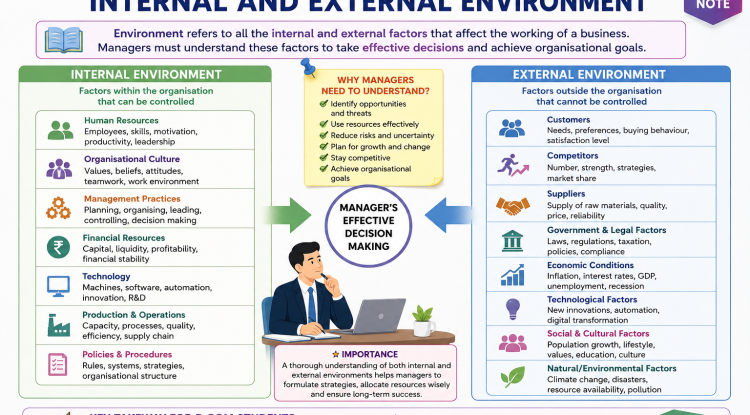
Every business operates in a dynamic environment that influences its performance and long-term success. Managers must understand both the internal environment (factors within the organisation) and the external environment (factors outside the organisation) to make informed decisions, adapt to changes, and achieve organisational goals. A clear understanding of these environments helps managers identify opportunities, overcome challenges, and maintain a competitive advantage. The internal environment includes all the factors within an organisation that directly affect its operations. These factors include employees, organisational culture, management practices, financial resources, technology, production capabilities, and company policies. Managers analyse these elements to identify the organisation's strengths and weaknesses.
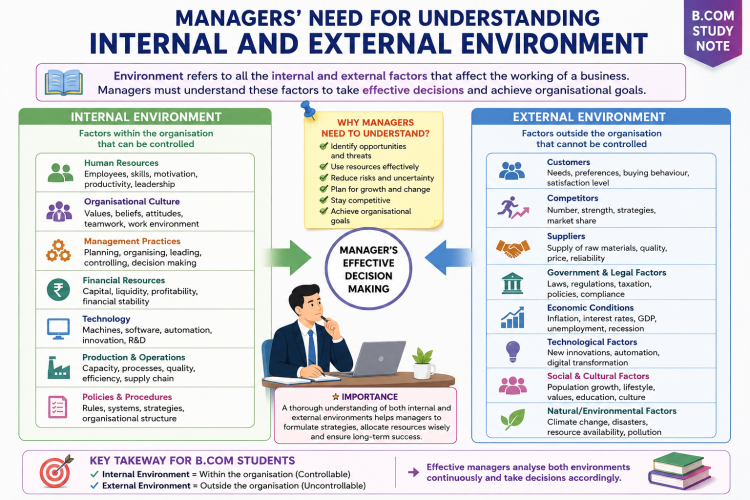
The Business Environment
To set your mind and visualize how these environments interact, review the hierarchical breakdown below:
| Level 1: The Core | Level 2: The Environments | Level 3: The Components | Level 4: The Specific Factors (PESTLE) |
| Business Environment | Internal Environment | Value System, Human Resources | N/A |
| Management Structure, Assets | N/A | ||
| Labor Unions | N/A | ||
| External Environment | Micro Environment | Customers, Suppliers, Competitors, Intermediaries | |
| Macro Environment | Political, Economic | ||
| Social/Cultural, Technological | |||
| Legal, Environmental |
The Business Environment: An Overview
- For a manager, a business does not operate in a vacuum. It is a living, breathing entity that constantly interacts with its surroundings.
- The Business Environment refers to the sum total of all individuals, institutions, and other forces that are outside the control of the business enterprise but still affect its overall performance and sustainability.
- Understanding the business environment is the absolute bedrock of strategic management. A manager's primary job is to steer the ship. To do that successfully, they must understand both the machinery inside the ship (Internal Environment) and the weather, currents, and obstacles outside (External Environment).
Part 1: The Internal Environment (Inside the Organization)
The internal environment consists of conditions and forces within an organization that directly affect its operations, decisions, and overall behavior. These are factors that the management can generally control or heavily influence.
Key Components of the Internal Environment:
-
Value System and Corporate Culture: This encompasses the ethical beliefs, work climate, and core values that guide how employees behave and how business is conducted.
-
Human Resources (Employees): This refers to the skill level, morale, motivation, and commitment of the workforce. They are the true engine of the company.
-
Management Structure and Policies: This dictates the hierarchy, decision-making processes, and internal rules. It defines whether a company operates with a rigid, top-down structure or a flexible, flat one.
-
Physical and Financial Assets: These are the tangible resources like cash reserves, manufacturing plants, technology, machinery, and office spaces.
-
Labor Unions: These are the internal bodies representing worker rights, which heavily influence wage negotiations and workplace policies.
Why Managers Need to Understand the Internal Environment:
-
Resource Optimization:
A manager must know exactly what financial and human resources they have before taking on a new project. You cannot plan to build a skyscraper if you only have the budget and workforce for a two-story house. -
Identifying Strengths and Weaknesses:
By auditing internal operations, managers know what their company does best (e.g., highly skilled IT team) and where they are vulnerable (e.g., outdated manufacturing equipment). -
Building Employee Morale:
Understanding the internal culture helps managers communicate better, resolve conflicts, and keep productivity high.
Real-Life Application: Tata Consultancy Services (TCS) During the COVID-19 pandemic, TCS managers deeply understood their internal environment—specifically their robust IT infrastructure and highly adaptable human resources. Because they knew their internal strengths, they rapidly implemented the "Secure Borderless Workspaces" (SBWS) model, moving thousands of employees to remote work almost overnight without a drop in productivity.
Part 2: The External Environment (Outside the Organization)
The external environment encompasses all the factors outside the organization that offer opportunities or pose threats to it. Managers have little to no control over these factors, which means they must constantly adapt to them. The external environment is divided into two sub-categories: Micro and Macro.
A. The Micro Environment (Task/Operating Environment)
These are the forces close to the company that directly affect its daily ability to serve its customers.
-
Customers: They are the lifeblood of the business. Managers must understand their changing tastes, income levels, and preferences.
-
Suppliers: These are the people who provide the raw materials. If a supplier raises prices or faces a shortage, it directly impacts the company's production.
-
Competitors: These are other companies fighting for the same customer base. Managers must anticipate competitors' moves.
-
Intermediaries: This group includes wholesalers, retailers, and delivery partners who help distribute the product to the final consumer.
B. The Macro Environment (General Environment)
These are the broader societal forces that affect the entire industry, not just one specific company. We often use the PESTLE framework to analyze this:
-
Political: Involves government stability, taxation policies, and foreign trade regulations.
-
Economic: Includes inflation rates, GDP growth, interest rates, and consumer purchasing power.
-
Social/Cultural: Focuses on demographics, lifestyle changes, cultural shifts, and education levels.
-
Technological: Examines the pace of innovation, automation, and R&D activity (e.g., the rise of Artificial Intelligence).
-
Legal: Covers employment laws, health and safety regulations, and consumer protection acts.
-
Environmental: Looks at climate change, waste disposal regulations, and the push for sustainable, green business practices.
Why Managers Need to Understand the External Environment:
-
Spotting Opportunities (First-Mover Advantage):
By monitoring social and technological trends, a manager can launch a product before competitors even realize there is a demand. -
Mitigating Threats and Risks:
If a manager knows a new tax law (Legal/Political) is about to be passed, they can adjust their pricing strategy in advance to protect their profit margins. -
Strategic Agility:
Markets change rapidly. A manager who understands the external environment can pivot the business model to survive economic downturns or global crises.
Real-Life Application: Reliance Jio (Disrupting the Macro Environment) Before 2016, data was incredibly expensive in India. Reliance's management analyzed the Macro Environment (Economic & Technological) and realized there was a massive untapped demographic of young, aspirational Indians who wanted the internet but couldn't afford it. They also looked at their Internal Environment (massive capital reserves). By launching Jio with free/ultra-cheap data, they completely disrupted the Micro Environment (Competitors), forcing giants like Vodafone and Idea to merge just to survive.
Part 3: The Intersection (SWOT Analysis)
The ultimate reason managers must understand both environments is to perform a SWOT Analysis. This analytical framework is where the internal and external environments intersect.
-
Strengths (Internal): What do we do better than anyone else?
-
Weaknesses (Internal): Where are we lacking resources or talent?
-
Opportunities (External): What external trends can we capitalize on?
-
Threats (External): What competitors or economic factors could destroy us?
What's Your Reaction?