Government and Business (Private and Public Sectors)
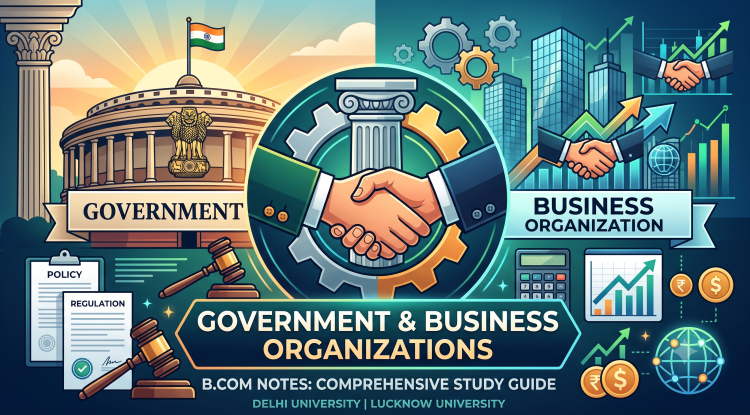
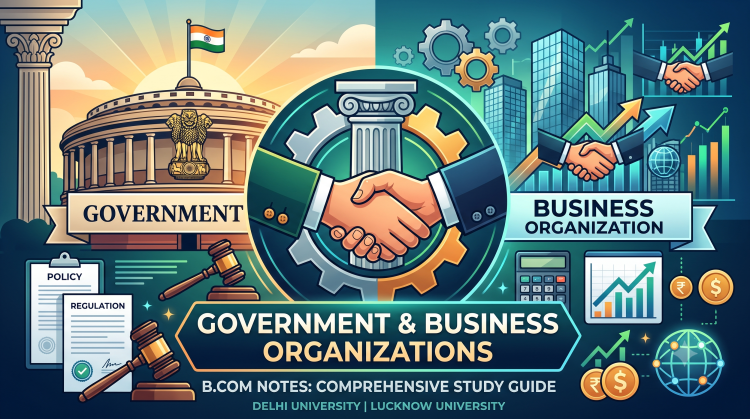
In the modern economic system, a business does not and cannot operate in a vacuum. It functions within a framework established by the state. The relationship between the government and business is one of the most critical aspects of the Macro Business Environment. Understanding this dynamic is essential for students of Business Organisation, as the government acts simultaneously as a referee, a promoter, a planner, and sometimes even as a competitor in the marketplace.
Introduction : The Framework of Interaction
Historically, the relationship between the government and business has evolved significantly.Â
Under the classical Laissez-Faire Approach (propounded by Adam Smith), the Government's role was restricted merel to maintaining law and order and protecting private property.
However, in mordern mixed economy like India, the government actively intervenes to ensure that busines growth aligns with the borader goals of social welfare, equitable wealth distribution, and nationala security. the government establishes the "rules of the game" through fiscal policies,
monetary policies, and legal frameworks, while businesses drive innovation, employment, and wealth creation.
Key Takeaways:
The relationships is symbiotic. The government relies on businesses for economic growth and tax revenue, while buisinesses rely on the government for infrastructure, legal protection, and economic stability.
Topic Flowchart: Roles of the Government in Business
| Level 1 The Core Entity | Level 2: Primary Roles | Level 3: Key Functions & Mechanisms | Level 4: Real World Indian Examples |
| Government | Regulartory Role | Licensing Quotas, Quality Control, Anti- Monopol Laws |
SEBI, RBI, Competition |
| Promotional Role | Subsidies, Tax Holidays, Infrastructure, Export Incentives | Make In India, SEZs, MSME SUBSIDIES | |
| Entrepreneurial Role | State ownership of key industries, Public Utilities | Indian Railways, LIC, ISRO, BSNL | |
| Planning Role | Economic forecasting, Resource allocation, Policy drafting | NITI Aayog, Union Budget |
The Four Primary Roles Of Government In Business
The interaction between the state and the corporate sector can be broadly categorized into four distinct roles.
a. The Regulatory Role (The Government As a Referee)
In its regulatory capacity, the government sets the boundaries within which business must operate. The goal is to prevent unfair trade practices, Protect consumer rights, and ensure environmental sustainability. Without regulation, free markets can lead to monopolies, worker, and environmental degradation.
- Financial Regulation:
Regulating capital markets and banking to protect investors (e.g., SEBI regulating the stock market to prevent inside trading; the RBI controlling Monetary Policy). - Checking Monopolies:
Ensuring fair competition so that large corporations do not crush small businesses or artificially inflate prices. -
Consumer Protection:
Enacting laws like the Consumer Protection Act, 2019 to save buyers from adulterated goods and misleading advertisements. -
Environmental Protection:
Enforcing compliance through bodies like the National Green Tribunal (NGT) to ensure corporate factories do not pollute public resources.
b. The Promotional and Development Role (The Government as a coach)
Here, the government actively encourages and supports business growth, especially in sectors that are crucial for national development but might be too risky for private investors to handle entirely on their own.
-
Infrastructure Development:
Building highways, ports, and power plants that reduce logistics costs for businesses. -
Financial Assistance:
Providing low-interest loans, subsidies, and tax holidays to startups and MSMEs (Micro, Small, and Medium Enterprises). -
Special Economic Zones (SEZs):
Creating specific geographical areas with liberal economic laws to boost foreign investment and exports. -
Skill Development:
Funding education and vocational training to ensure businesses have a steady supply of skilled labor.
c. The Entrepreneurial Role (The Government as a Player)
In a mixed economy, the government does not just regulate and promote; it also steps into the market to run businesses itself. These are known as Public Sector Undertakings (PSUs) or State-Owned Enterprises.
-
Strategic Monopolies:
Sectors vital for national security or massive public welfare are often kept under state control (e.g., Defense equipment manufacturing, Atomic Energy, Indian Railways). -
Capital Intensive Industries:
In the early years of independence, the Indian private sector lacked the massive capital required to build steel plants and heavy machinery. The government stepped in to build enterprises like SAIL and BHEL. -
Welfare over Profit:
While private businesses run purely on a profit motive, government businesses often operate on a service motive, ensuring essential services (like postal networks) reach remote, unprofitable rural areas.
d. The Planning Role (The Government as a Strategist)
The government determines the macro-economic direction of the country. By utilizing national resources optimally, it ensures balanced regional development.
-
Economic Policies:
Drafting Industrial Policies, EXIM (Export-Import) Policies, and the Annual Union Budget to dictate where the economy should head. -
Institutional Planning:
Previously handled by the Planning Commission (via Five-Year Plans), this role is now driven by NITI Aayog, which acts as a strategic think tank to guide the nation's economic growth path.
Why Does the Government Need to Intervene?
(The Rationale)
If free markets are efficient, why does the government need to step in at all? The necessity for government intervention arises from several "Market Failures" and socio-economic imperatives:
-
Prevention of Monopolistic Exploitation:
Left unchecked, a single massive company could dominate a sector and charge consumers exorbitant prices. The government intervenes through anti-trust laws to maintain a level playing field. -
Balanced Regional Development:
Private businesses prefer to set up factories in highly developed states (like Maharashtra or Gujarat) where infrastructure already exists. To prevent poorer states from being left behind, the government provides massive tax incentives for companies to set up plants in backward or rural areas. -
Protection of Labor:
The pure profit motive can lead to low wages and terrible working conditions. The government enforces the Minimum Wages Act and the Factories Act to protect the human resources of the nation. -
Managing Externalities:
Businesses often generate negative externalities (like pollution). A factory might make cheap paper, but it might dump toxic chemicals into a local river. The government steps in to fine or shut down such operations to protect the public good.
Real-Life Case Studies: The Indian Context
To score top marks, university students must apply theoretical knowledge to real-world scenarios. Here is how the government-business dynamic plays out in modern India:
Case Study 1: The Regulatory Role — CCI vs. Google (2022)
In a massive display of its regulatory power, the Competition Commission of India (CCI) slapped a fine of over ₹1,337 Crore on Google. The government body ruled that Google was abusing its dominant position in the Android mobile device ecosystem to crush local competitors. This is a perfect example of the government acting as a referee to maintain fair market competition.
Case Study 2: The Promotional Role — FAME India & EV Subsidies
To reduce India's reliance on imported crude oil and tackle pollution, the government launched the FAME (Faster Adoption and Manufacturing of Hybrid and Electric Vehicles) scheme. Under this, the government provides massive subsidies to companies manufacturing EVs (like Tata Motors and Ola Electric) and to consumers buying them. This illustrates the government financially promoting a sector for long-term national benefit.
Case Study 3: The Changing Entrepreneurial Role — Air India Privatization
Historically, the government ran Air India as a PSU. However, recognizing that running a commercial airline is not a strategic imperative and was causing a massive drain on taxpayer money, the government officially handed Air India back to the Tata Group in 2022. This highlights the modern shift in the government's strategy: moving away from the entrepreneurial role in non-strategic sectors to focus more on regulation and promotion.
The Evolution: From License Raj to LPG (1991)
No study of the Government-Business relationship in India is complete without understanding the watershed year of 1991.
-
Pre-1991 (The License Raj): The relationship was heavily tilted toward absolute government control. Businesses needed government licenses for everything—to start a company, to expand production capacity, and to import raw materials. This led to massive red tape, corruption, and an inefficient, stagnant economy.
-
Post-1991 (Liberalization, Privatization, Globalization): Facing a severe balance of payments crisis, the Indian government dramatically changed its relationship with business. It dismantled the License Raj, opened doors to Foreign Direct Investment (FDI), and shifted its primary stance from being a strict "Controller" to a "Facilitator" of business.
Summary
The relationship between government and business is a delicate balancing act. If the government over-regulates, it stifles innovation, discourages investment, and slows down economic growth. If it under-regulates, it risks environmental destruction, labor exploitation, and consumer fraud.
For a modern economy to thrive, the relationship must be a partnership—where businesses are given the freedom and infrastructure to innovate and generate wealth, while the government maintains a vigilant framework to ensure that this wealth ultimately serves the greater good of the society.
What's Your Reaction?