Business Environment
Business Environment designed for a Business Organisation semester course. These notes are structured to provide a deep dive into the concepts, frameworks, and strategic implications of the environment in which businesses operate.
Introduction: Business Environment
A business does not operate in vaccum. It is deeply embedded within a complex, dynamic system of external and internal forces. The Business Environment refers to the totality of all individuals, instituions, and other forces that are outside the direct control of a business but may affect its performance.
According to Arthur M. Weimer,
- " Business environment encompases the climate or set of conditions, economic, social, political or institutional in which business operations are conducted."
To survive in thrive, a business must continuously monitor, adapt to, and sometimes attempt to influence these environmental forces.The relationship between a business and its environment is highly symbiotic:
- The environment provides resources (capital, labor, materials) and opportunities, while the business provides goods and services to fulfill environmental needs.
Key Characteristics of the Business Environment
Understanding the nature of the business environment requires recognizing its defining features:
-
Totality of External Forces: The environment is aggregative in nature. It consists of all external forces, institutions, and factors combined.
-
Specific and General Forces: It includes both specific forces (customers, competitors, investors) that affect individual enterprises directly, and general forces (economic, social, political conditions) that affect all enterprises indirectly.
-
Dynamic Nature: The environment is highly fluid. Technological shifts, changing consumer preferences, and new government regulations mean that the environment is constantly evolving.
-
Complexity: Because it consists of numerous interconnected factors, it is easy to understand the environment in parts, but difficult to grasp it in its totality.
-
Relativity: The business environment is a relative concept; it differs from country to country and even region to region. The political environment in the US is vastly different from that in China or India.
-
Uncertainty: It is incredibly difficult to predict future environmental changes accurately, particularly in rapidly changing fields like technology or fashion.
The Importance of Environmental Scanning
Environmental scanning is the process by which organizations monitor their relevant environment to identify opportunities and threats affecting their business for the purpose of making strategic decisions.
-
First Mover Advantage:
By identifying environmental trends early, firms can capitalize on opportunities before competitors. (e.g., Tesla's early push into electric vehicles). -
Early Warning Signal:
It helps businesses identify potential threats and take corrective measures before a crisis hits. -
Customer Focus:
Continuous monitoring helps businesses adapt to changing consumer preferences, ensuring they remain relevant. -
Strategy Formulation:
It provides the raw data necessary for strategic planning. You cannot plot a course for the future without knowing the terrain. -
Image Building:
A business that proactively responds to its environment (e.g., adopting green technologies) improves its public image. -
Continuous Learning:
Managers who regularly analyze the environment stay educated and adaptable.
Components of the Business Environment
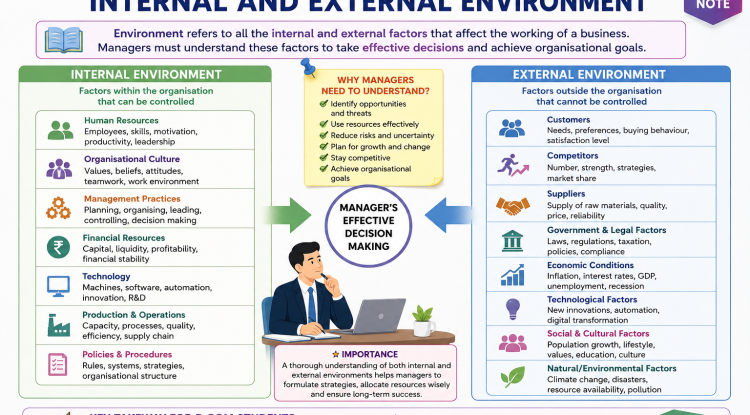
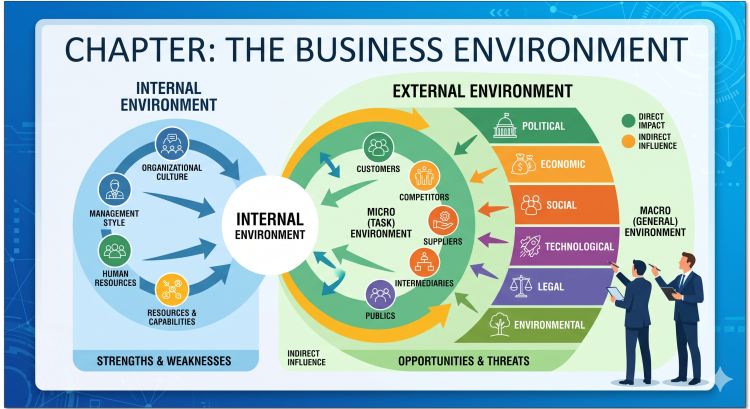
The business environment is broadly classified into two main categories: the Internal Environment and the External Environment.
The Internal Environment
These are the forces that operate within the organization and are generally under the control of management. They define the organization's strengths and weaknesses.
-
Value System:
The ethical beliefs and moral principles that guide the founders and top management. -
Mission and Objectives:
The organization's fundamental purpose and the goals it seeks to achieve. -
Organizational Structure:
The hierarchy of authority, communication channels, and division of labor. -
Corporate Culture:
The shared values, attitudes, and norms of behavior within the company. -
Human Resources:
The quality, skill, morale, and commitment of the workforce. -
Physical and Financial Resources:
Access to capital, modern machinery, logistical capabilities, and technological assets.
The External Environment
These are the forces outside the organization. Management has little to no direct control over them. The external environment is further divided into the Micro Environment and the Macro Environment.
The Micro Environment (Task Environment)
The Micro Environment consists of factors in the company's immediate environment that directly affect its performance and daily operations. While the company cannot fully control these factors, it can influence them.
Key Micro-Environmental Factors:
-
Suppliers:
Suppliers provide the raw materials, components, and equipment necessary for production. A reliable supply chain is critical. If a supplier raises prices or goes bankrupt, it directly impacts the business's cost structure and production timeline. Strategic response: Maintain multiple suppliers to avoid dependency. -
Customers:
The ultimate aim of any business is to create and retain customers. Customer tastes, preferences, and purchasing power dictate what a business should produce. Categories of customers include individuals, households, industrial consumers, and governments. -
Competitors:
A business must closely monitor its rivals. Competitors define the pricing, marketing, and innovation standards in an industry. Analyzing competitors involves understanding their market share, product offerings, and strategic moves. -
Marketing Intermediaries:
These are the entities that help the company promote, sell, and distribute its products to final buyers. They include middlemen (wholesalers, retailers), physical distribution firms (logistics), marketing service agencies, and financial intermediaries (banks, insurance companies). -
Publics:
A "public" is any group that has an actual or potential interest in, or impact on, a company’s ability to achieve its objectives. This includes media publics (newspapers, blogs), citizen-action publics (environmental groups, consumer organizations), and local publics (neighborhood residents).
The Macro Environment (General Environment)
The Macro Environment consists of larger societal forces that affect the entire micro-environment. A business cannot influence these forces; it can only adapt its strategies to accommodate them. The standard framework for analyzing the macro environment is the PESTLE Analysis.
P - Political Environment
The political environment encompasses the actions, policies, and stability of the government.
-
Government Stability: A stable government encourages business investment, while political turmoil creates risk and capital flight.
-
Ideology of the Ruling Party: Whether a government is pro-business (capitalist leaning) or strictly regulatory (socialist leaning) impacts how companies operate.
-
Foreign Policy: The political relationship between the home country and foreign nations affects international trade, tariffs, and expansion opportunities.
E - Economic Environment
This is perhaps the most direct macro-factor impacting business viability. It refers to the nature and direction of the economy in which a firm operates.
-
Economic Systems: The prevailing framework (Capitalism, Socialism, or a Mixed Economy).
-
Economic Conditions: The general state of the economy, defined by GDP growth rates, per capita income, inflation, unemployment rates, and interest rates. High inflation reduces consumer purchasing power, while high interest rates make borrowing expensive for businesses.
-
Economic Policies:
-
Monetary Policy: Central bank actions regarding money supply and interest rates.
-
Fiscal Policy: Government taxation and public spending.
-
Industrial Policy: Government regulations regarding industrial licensing, foreign investment, and subsidies.
-
S - Socio-Cultural Environment
This encompasses the demographic characteristics, norms, customs, and values of the population within which the organization operates.
-
Demographics: The size, density, age structure, gender ratio, and educational profile of the population. An aging population creates demand for healthcare and retirement services, while a youth-heavy demographic drives demand for education, fast food, and electronics.
-
Social Institutions & Class Structure: The role of family, marriage, and social mobility.
-
Cultural Values: Consumer preferences are heavily dictated by culture. For example, food and beverage companies must drastically alter their menus when entering markets with strict dietary customs based on religion or tradition.
T - Technological Environment
Technology is the most dramatic force shaping the destiny of businesses today. It destroys old industries and creates new ones.
-
Pace of Change: The speed at which new technologies are developed and adopted (e.g., AI, blockchain, IoT).
-
R&D Budgets: The amount of capital being invested in research and development by the government and private sector.
-
Digital Transformation: The shift toward e-commerce, remote work infrastructures, and automated supply chains. Businesses that fail to adapt to technological shifts (e.g., Blockbuster failing to adapt to streaming) face obsolescence.
L - Legal Environment
The legal environment consists of the laws and regulatory frameworks passed by the government that businesses must abide by.
-
Corporate Laws: Regulations regarding company formation, governance, and dissolution (e.g., The Companies Act).
-
Consumer Protection: Laws designed to ensure fair trade, product safety, and truthful advertising.
-
Labor Laws: Minimum wage requirements, workplace safety standards, and regulations regarding unionization and employee termination.
-
Intellectual Property: Patent, copyright, and trademark laws that protect innovations.
E - Environmental (Ecological) Environment
In the modern context, the natural environment is a critical business factor.
-
Resource Scarcity: The depletion of natural resources (water, minerals, fossil fuels) affects production costs.
-
Climate Change: Extreme weather events can disrupt supply chains and physically damage infrastructure.
-
Sustainability Demands: Consumers and governments increasingly demand that businesses adopt "green" practices, reduce carbon footprints, and implement circular economies (recycling and waste reduction).
The Global and International Environment
In an era of globalization, the business environment is no longer confined to national borders. Even small local businesses are impacted by global forces.
-
Globalization: The integration of national economies through trade, investment, capital flow, and labor migration. It opens up new markets but also introduces foreign competition into domestic markets.
-
International Institutions: Organizations like the World Trade Organization (WTO), International Monetary Fund (IMF), and the World Bank set the rules for international trade and finance.
-
Multinational Corporations (MNCs): Large corporations operating in multiple countries heavily influence global business practices, technology transfer, and capital movement.
-
Foreign Direct Investment (FDI): The flow of capital from one nation into the enterprises of another. Favorable FDI policies can transform a developing country's industrial landscape.
- Exchange Rates: Fluctuations in currency values directly impact the profitability of importers and exporters.
Navigating the Modern Context: The VUCA World
Modern business strategy frequently refers to the current business environment as VUCA:
| Characteristic | Definition | Strategic Response |
| Volatility | The speed, volume, and magnitude of unexpected change. | Build agility and operational buffers (e.g., stockpiling critical inventory). |
| Uncertainty | The lack of predictability and information about future events. | Invest in information gathering, environmental scanning, and scenario planning. |
| Complexity | The multiple, interconnected variables confusing the environment. | Restructure to align with the complexity; hire specialists and build robust networks. |
| Ambiguity | The haziness of reality; the potential for misreads and mixed meanings. | Foster a culture of experimentation and rapid prototyping to test hypotheses. |
Conclusion
The business environment is a complex, multifaceted web of influences. A successful business organization is not merely a passive entity buffeted by external forces; it is an active participant that must analyze, adapt to, and occasionally shape its environment.
By mastering environmental analysis—understanding the internal strengths and weaknesses, navigating the immediate micro-environment, and anticipating the massive shifts in the macro-environment through PESTLE analysis—managers can formulate strategies that ensure long-term survival, profitability, and sustainable growth in an increasingly volatile global landscape.
Files
What's Your Reaction?