2008 Global Financial Crisis
The 2008 Global Financial Crisis was one of the most severe economic downturns since the Great Depression of the 1930s. It began in the United States housing market and quickly spread across the global financial system, affecting banks, stock markets, businesses, and millions of people worldwide. Background of the Crisis In the early 2000's, banks in the United States started giving subprime mortgage loans to borrowers with low creditworthiness. These risky loans were bundled into complex financial products called mortgage-backed securities and sold to investors worldwide. When housing prices began to fall and borrowers failed to repay their loans, the financial system started collapsing.
2008 Global Financial Crisis
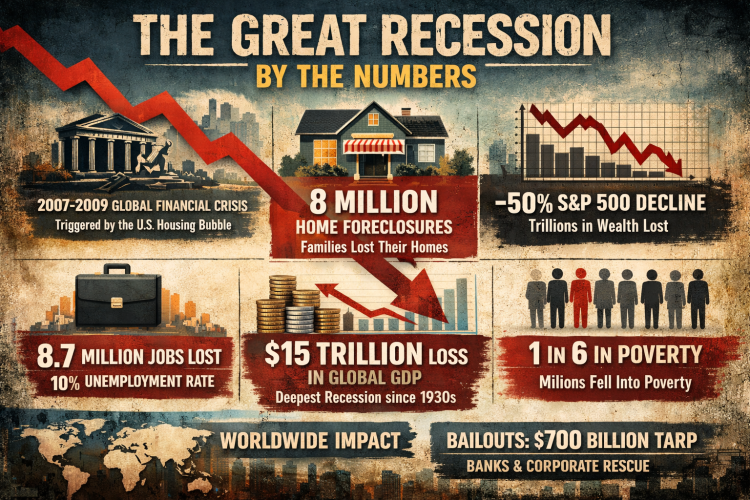
The 2008 Global Financial Crisis was a worldwide economic collapse that began in the United States with the bursting of the housing bubble and rapidly spread through interconnected financial systems. It led to the most severe recession since the Great Depression, resulting in mass unemployment, collapsing asset prices, and sweeping government interventions across major economies.
Key facts
-
Duration: 2007 – 2009 (effects persisted for years)
-
Epicenter: United States, global spread
-
Major trigger: Collapse of U.S. subprime mortgage market
-
Peak failure: Lehman Brothers collapse, September 2008
-
Estimated job losses: 8–9 million in the U.S. alone

Origins and Causes
Low interest rates and financial deregulation after 2000 encouraged speculative lending and borrowing, especially in housing. Banks issued vast numbers of high-risk “subprime” mortgages and repackaged them into mortgage-backed securities and collateralized debt obligations sold globally. When housing prices fell in 2006–2007, defaults surged, eroding confidence in these assets and freezing credit markets. Excessive leverage, weak oversight, and overreliance on flawed credit ratings amplified systemic risk.
The Crisis Unfolds
In 2008, major financial firms—including Bear Stearns, Lehman Brothers, and insurer AIG—collapsed or required government bailouts. Global credit markets seized, stock indices lost over half their value, and international trade contracted sharply. The ensuing panic became the Great Recession, a synchronized global contraction of output and employment.
Policy Responses
Governments and central banks intervened on an unprecedented scale. The U.S. launched the Troubled Asset Relief Program and the American Recovery and Reinvestment Act; the Federal Reserve cut rates to near zero and introduced quantitative easing. Europe, China, and other economies enacted large fiscal stimulus and bank-support measures. Coordinated action through the Group of Twenty helped stabilize the global system.
Aftermath and Reforms
The crisis caused trillions in wealth destruction and spurred lasting regulatory change. In the U.S., the Dodd-Frank Wall Street Reform and Consumer Protection Act tightened oversight of banks and derivatives, while the Basel III accord raised global capital requirements. Political and social consequences included rising populism and distrust in financial elites, illustrated by movements like Occupy Wall Street.
Legacy
The 2008 Global Financial Crisis redefined modern finance and policymaking, embedding financial-stability mandates in central banking and reshaping global economic governance. Its lessons—on leverage, transparency, and systemic risk—continue to guide regulators and economists seeking to prevent another global collapse.
2008 Global Financial Crisis – Tabular Assumptions
For blog or academic explanation, the crisis can be understood through key assumptions/conditions that existed before the collapse. These assumptions explain why the financial system became unstable.
| No. | Assumption / Condition | Explanation |
|---|---|---|
| 1 | Continuous Rise in Housing Prices | Banks and investors assumed that housing prices in the United States would always increase, making mortgage investments appear safe. |
| 2 | High Demand for Mortgage Securities | Financial institutions believed that global investors would continuously buy Mortgage‑Backed Securities (MBS) and related assets. |
| 3 | Borrowers Would Repay Loans | Banks assumed most borrowers, even those with poor credit (subprime borrowers), would repay their mortgage loans. |
| 4 | Credit Rating Agencies Were Accurate | Investors trusted ratings from agencies like Moody’s and Standard & Poor’s, assuming complex securities were low risk. |
| 5 | Financial Institutions Were Stable | Large banks such as Lehman Brothers were assumed to be financially strong and unlikely to fail. |
| 6 | Easy Credit Would Continue | Low interest rates set by the Federal Reserve encouraged borrowing, and markets assumed cheap credit would last for years. |
| 7 | Global Financial Markets Were Resilient | Policymakers believed international financial markets could absorb shocks without major collapse. |
| 8 | Government Would Prevent Major Failures | Many investors assumed governments would rescue large institutions if problems occurred. |
What's Your Reaction?