Quantity Theory of money (Fisher’s): Assumptions and Criticism
This chapter provides a comprehensive understanding of Fisher's Quantity Theory of Money, including its assumptions, working mechanism, significance, advantages, limitations, and major criticisms. It explains the key variables of the equation, discusses how changes in money supply affect inflation and economic stability, and examines why modern economists have criticised some of the theory's assumptions. The chapter is designed to help B.Com students build a strong conceptual understanding of monetary theory and its relevance in the study of currency, banking, and exchange.
Introduction to the Quantity Theory of Money
The Quantity Theory of Money (QTM) is one of the oldest concepts in macroeconomic theory, tracing its roots back to the 16th century and classical economists like David Hume and John Stuart Mill. However, it was the American economist Irving Fisher who provided the most systematic and famous mathematical formulation of this theory in his 1911 book, The Purchasing Power of Money.
At its core, Fisher's Quantity Theory of Money seeks to explain the primary determinant of the general price level in an economy. The theory posits a direct and proportional relationship between the total supply of money in an economy and the general price level of goods and services.
According to Fisher,
- Â "Other things remaining unchanged, as the quantity of money in circulation increases, the price level also increases in direct proportion and the value of money decreases, and vice versa."
In simpler terms, if the money supply doubles, prices will double, and the purchasing power of a single unit of currency will be cut in half.
Definition
According to Irving Fisher:
"Other things remaining the same, the price level changes in direct proportion to the quantity of money."
This means that if the quantity of money doubles, prices will also double, provided other factors remain unchanged.
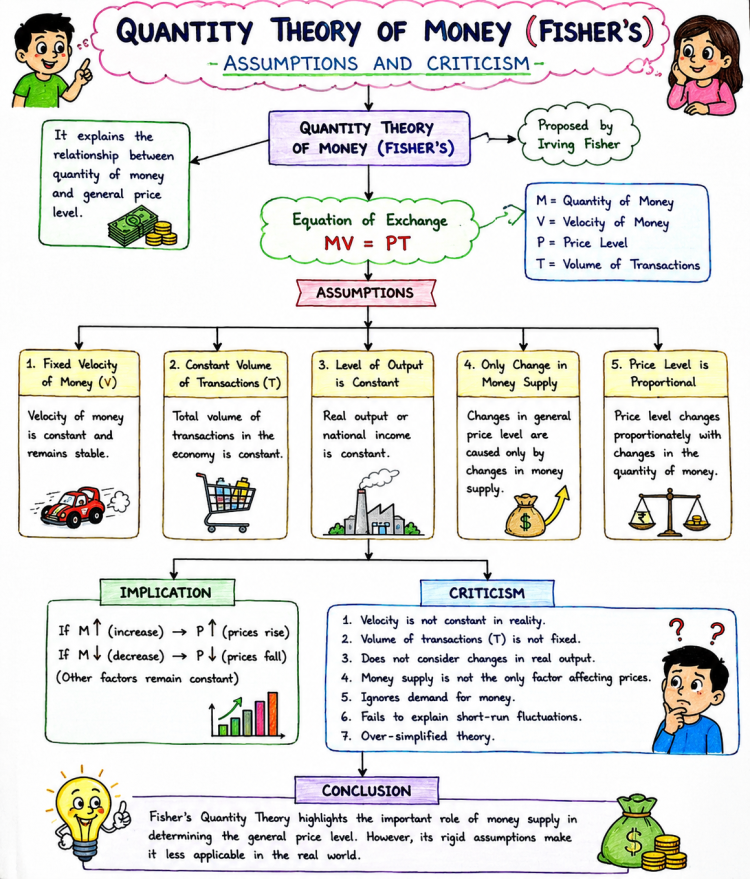
*The theory is represented by the famous Equation of Exchange:*
MV = PT
where:
- M = Quantity (Supply) of Money
- V = Velocity of Circulation of Money
- P = Average Price Level
- T = Total Volume of Transactions
According to Fisher, if the quantity of money increases while the velocity of money and the volume of transactions remain constant, the price level will increase proportionately. Likewise, a decrease in the money supply will reduce the general price level.
Although this theory became the foundation of classical monetary economics, it has also faced several criticisms due to its unrealistic assumptions.
V – Velocity of Money
Velocity means the number of times one unit of money changes hands during a given period.
Example: Suppose ₹100 is used five times in one month to purchase different goods.
Then, Velocity = 5 Higher velocity means money circulates faster.
P – Price Level
Price level represents the average prices of goods and services in the economy.
It indicates inflation or deflation.
T – Volume of Transactions
T refers to the total number of transactions involving goods and services during a period.
Greater production generally leads to a higher value of T.
How the Theory Works
Suppose:
Money Supply (M) = ₹1,000
Velocity (V) = 5
Transactions (T) = 500
Using the equation:
MV = PT
1000 × 5 = P × 500
5000 = 500P
P = 10
Now suppose the money supply doubles to ₹2,000 while V and T remain constant.
2000 × 5 = P × 500
10000 = 500P
P = 20
The price level doubles from 10 to 20.
This demonstrates Fisher's conclusion that prices rise proportionately with an increase in money supply.
Meaning of Quantity Theory of Money
The Quantity Theory of Money states that the value of money depends upon the quantity of money available in the economy.
It suggests that:
- When the supply of money increases, the purchasing power of money decreases.
- When the supply of money decreases, the purchasing power of money increases.
Therefore,
Money Supply ↑ = Price Level ↑ = Purchasing Power ↓
and
Money Supply ↓ = Price Level ↓ = Purchasing Power ↑
The theory assumes that changes in money supply are the primary cause of changes in the general price level.
Assumptions of Fisher's Quantity Theory of Money
The validity of Fisher's theory depends on several assumptions.
1. Velocity of Money (V) Remains Constant
The theory assumes that people spend money at the same speed throughout the year.
In reality:
- Digital payments
- Banking habits
- Consumer confidence
can all change the velocity of money.
Example
If people start saving more during an economic slowdown, velocity decreases.
2. Volume of Transactions (T) is Constant
The theory assumes that production and transactions remain unchanged.
It believes the economy is operating at full employment.
Example
A factory producing 10,000 units every month continues producing exactly the same amount.
3. Full Employment Exists
Fisher assumes all resources are fully utilized.
There is:
- No unemployment
- No idle resources
Therefore, increased money supply only raises prices rather than production.
4. Money Supply is the Only Factor Affecting Prices
The theory assumes price changes occur only because of changes in money supply.
It ignores:
- Demand
- Supply
- Government policies
- Technology
- Production costs
5. Economy is Perfectly Competitive
The theory assumes:
- No monopoly
- No government interference
- Perfect competition
Prices adjust freely.
6. Stable Banking System
Banks do not unexpectedly expand or contract credit.
Credit creation remains constant.
7. No Hoarding of Money
People spend money rather than keeping it idle.
All money participates in transactions.
8. Proportionate Relationship
The theory assumes a 100% proportional relationship between money supply and price level.
If money doubles,
prices also double.
Main Features of Fisher's Theory
- Simple and easy to understand.
- Explains inflation through money supply.
- Uses a mathematical equation.
- Treats money as a medium of exchange.
- Emphasizes the role of monetary policy.
- Based on long-run analysis.
Importance of the Quantity Theory of Money
1. Explains Inflation
The theory explains that excessive money supply causes inflation.
Example
If the government prints too much money, prices increase.
2. Helps Central Banks
Central banks regulate money supply using monetary policy.
Example:
Increasing interest rates reduces money supply and controls inflation.
3. Foundation of Monetary Economics
Many modern monetary theories evolved from Fisher's work.
4. Useful in Policy Making
Governments consider money supply while designing economic policies.
5. Basis for Monetary Stability
The theory highlights the importance of controlling money supply.
Advantages of Fisher's Quantity Theory
1. Simple Theory
The relationship between money supply and prices is easy to understand.
2. Mathematical Approach
The equation provides scientific analysis.
3. Explains Long-Term Inflation
Countries experiencing excessive money creation often experience inflation.
4. Useful for Monetary Policy
Helps governments control inflation through money supply management.
5. Foundation for Later Theories
Many economists expanded Fisher's ideas.
Criticism of Fisher's Quantity Theory of Money
Despite its importance, the theory has several weaknesses.
1. Velocity of Money is Not Constant
In reality, velocity changes frequently.
People may:
- Save more
- Spend less
- Use digital payments
These factors affect velocity.
2. Volume of Transactions is Not Constant
Production changes because of:
- Technology
- Investment
- Demand
- Employment
Therefore, T is variable.
3. Ignores Demand for Money
People hold money for several reasons:
- Transactions
- Precaution
- Speculation
Fisher ignored these motives.
4. Unrealistic Full Employment Assumption
Most economies experience unemployment.
Extra money may increase production instead of prices.
5. Oversimplifies Inflation
Inflation depends on many factors:
- Cost of production
- Supply shortages
- Government taxation
- Global oil prices
Money supply is not the only cause.
6. Ignores Interest Rates
Interest rates affect:
- Borrowing
- Investment
- Spending
The theory does not consider this relationship.
7. Credit Creation is Ignored
Modern economies rely heavily on bank credit.
Banks create purchasing power through loans.
Fisher focused mainly on currency.
8. Assumes Perfect Competition
Real markets often contain:
- Monopolies
- Oligopolies
- Government regulation
Hence prices do not adjust perfectly.
9. Short-Run Changes Cannot Be Explained
The theory works better in the long run.
It cannot explain:
- Business cycles
- Recessions
- Temporary inflation
10. Too Mechanical
The equation appears mathematical but ignores psychological factors.
Consumer confidence and expectations also affect prices.
Practical Example
Suppose:
Money Supply = ₹500 billion
Velocity = 4
Transactions = 200 billion goods
Then:
500 × 4 = P × 200
2000 = 200P
Price Level = 10
Now the government increases money supply to ₹1000 billion.
1000 × 4 = P × 200
4000 = 200P
Price Level = 20
According to Fisher,
prices double because money doubled.
However, if production also increases,
prices may not rise by the same proportion.
Relevance in Modern Economy
Although Fisher's theory has limitations, it remains highly relevant.
Today:
- Central banks monitor money supply.
- Inflation targeting depends partly on monetary control.
- Economists use modified versions of the theory.
Modern theories combine money supply with:
- Interest rates
- Aggregate demand
- Consumer expectations
- Economic growth
Thus, Fisher's theory remains an important starting point for understanding monetary economics.
Difference Between Fisher's Theory and
Modern View
| Basis | Fisher's Theory | Modern View |
|---|---|---|
| Money Supply | Main factor affecting prices | One of many factors |
| Velocity | Constant | Variable |
| Output | Constant | Changes over time |
| Inflation | Caused mainly by money supply | Multiple causes |
| Employment | Full employment assumed | Unemployment may exist |
| Time Period | Long run | Short run and long run |
Conclusion
The Quantity Theory of Money, developed by Irving Fisher, is one of the most influential classical theories in monetary economics. It explains that the general price level is directly related to the quantity of money circulating in the economy and is summarized by the famous equation MV = PT. The theory emphasizes that an increase in money supply, while other factors remain constant, leads to a proportionate rise in prices and a fall in the purchasing power of money.
Although the theory is based on several restrictive assumptions—such as constant velocity of money, fixed output, and full employment—it has played a significant role in shaping monetary policy and understanding inflation. Despite criticism for overlooking real-world complexities like changes in output, interest rates, credit creation, and consumer behavior, Fisher's framework remains a cornerstone of monetary economics and continues to influence modern discussions on money supply, inflation, and price stability.
- Exam Tip (B.Com): Remember the formula MV = PT, explain each variable clearly, write at least 5–8 assumptions and 8–10 criticisms, and support your answers with simple examples to score higher in university examinations.
What's Your Reaction?