CBSE new OSM Checking Method Student faced Struggle to get Great score Expectations gets Wrong
CBSE’s new OSM checking method has created major challenges for students expecting high scores in board examinations. This blog explores how strict evaluation, competency-based checking, analytical answer writing, and changing marking patterns are affecting student performance, confidence, and expectations across India’s education system.
CBSE’s New OSM Checking Method: When Student
Expectations Meet Harsh Reality
Introduction
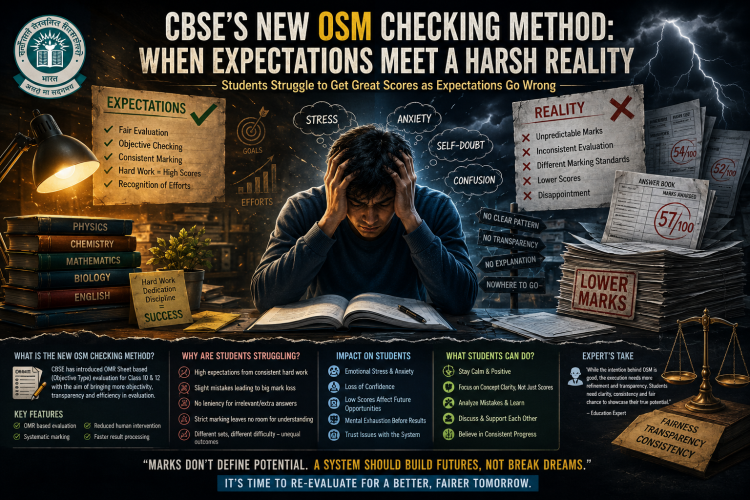
The Central Board of Secondary Education (CBSE) has recently adopted a stricter and more competency-based evaluation pattern through its new OSM checking method. While the objective behind this system is to improve transparency, consistency, and analytical learning, many students across India are struggling to achieve the scores they expected despite months of hard work.
The issue has sparked widespread discussion among students, parents, teachers, and educational experts. Many students feel that their expectations from the examination system no longer match the actual evaluation process.
What is the New OSM Checking Method?
The OSM (On-Screen Marking) checking method is a digital evaluation system where answer sheets are scanned and checked online by examiners following strict marking guidelines.
The system focuses more on:
- Accuracy of answers
- Concept clarity
- Step-by-step marking scheme
- Competency-based assessment
- Reduced examiner leniency
CBSE introduced this system to create a fair and standardized checking process across the country.
Why Are Students Struggling Under the New System?
1. High Expectations Based on Previous Trends
Many students prepared according to older checking patterns where presentation, handwriting, and partially correct answers often received extra marks.
However, the new OSM system is much stricter and focused mainly on exact content and concepts.
As a result:
- Students expected 90+
- But received lower-than-expected marks
This gap between effort and result created disappointment.
2. Strict Evaluation Pattern
Under the new checking system:
- Unnecessary explanations may not receive marks
- Keywords matter more
- Exact answer framing becomes important
- Small mistakes can lead to mark deductions
Students who wrote lengthy answers without precise points often lost marks.
3. Shift from Rote Learning to Analytical Learning
The new CBSE pattern emphasizes:
- Application-based questions
- Critical thinking
- Conceptual understanding
Students who focused only on memorization struggled to adapt to competency-based evaluation.
4. Lack of Awareness About New Checking Standards
Many schools and coaching institutes did not properly explain:
- How answers would be evaluated
- Importance of keywords
- Structured answering techniques
- Time management in competency-based papers
Because of this, students entered exams with outdated expectations.
Emotional Impact on Students
1. Stress and Anxiety
Students who worked consistently throughout the year felt mentally disturbed after seeing unexpected results.
Many started questioning:
- Their preparation
- Their abilities
- Their future goals
The Gap Between Expectations and Reality
| Student Expectations | Reality Under OSM |
|---|---|
| Hard work guarantees high marks | Accuracy matters more than effort |
| Long answers score better | Precise answers get marks |
| Presentation improves scores | Content clarity matters most |
| Partial knowledge gets marks | Strict marking reduces leniency |
| Previous paper style will continue | Evaluation pattern has changed |
What CBSE Should Improve
1. Better Communication
CBSE should clearly explain the new evaluation pattern to students and schools.
2. Sample Answer Training
Students should be shown model answers and marking schemes before exams.
3. Teacher Training
Teachers must be trained to prepare students according to competency-based checking.
4. Balanced Evaluation
Strictness should not completely ignore student effort and understanding.
What's Your Reaction?