Nature and Scope Of Business
Business is a dynamic economic activity involving the production, distribution, and exchange of goods and services for profit and customer satisfaction. Its nature is characterised by regular economic activities, profit motive, risk, and creation of utility.
Introduction
Business is an economic activity that involves the production, purchase, sale, and distribution of goods and services with the objective of earning profit and satisfying human wants. In modern society, business plays a vital role in economic development by creating employment opportunities, generating income, utilizing resources efficiently, and improving the standard of living.
The concept of business is broad and includes all activities related to manufacturing, trading, transportation, banking, insurance, communication, and other services. Business activities are carried out continuously and systematically to meet the needs of consumers while earning reasonable profits.
Meaning of Business
The term "business" refers to all those human activities which are directed toward the production or acquisition of wealth through buying and selling of goods and services.
According to Prof. L.H. Haney:
- "Business may be defined as human activities directed toward providing or acquiring wealth through buying and selling of goods."
Business is not merely concerned with earning profits; it also focuses on customer satisfaction, social welfare, and economic growth.
Characteristics (Nature) of Business
The nature of business can be understood through its important characteristics:
1. Economic Activity
Business is an economic activity because it is undertaken for earning income and wealth. It contributes to the economic development of a nation.
Example: A shopkeeper selling groceries to earn profit.
2. Production or Procurement of Goods and Services
Every business involves either producing goods or procuring them for sale.
Example:
- A factory manufactures shoes.
- A retailer purchases shoes from wholesalers and sells them to customers.
3. Sale or Exchange of Goods and Services
Business involves the transfer of goods and services from producers to consumers through sale or exchange.
Without sale, an activity cannot be termed as business.
Example: Manufacturing furniture for personal use is not business, but selling furniture is business.
4. Regularity of Transactions
Business activities must be conducted regularly and continuously.
A single transaction does not constitute business.
Example: Selling an old bicycle once is not business, but regularly selling bicycles is business.
5. Profit Motive
Profit is the primary objective of every business enterprise. It acts as a reward for taking risks and investing resources.
Profit helps in:
- Expansion of business
- Survival of enterprise
- Rewarding investors
6. Element of Risk
Every business involves uncertainty regarding profits and losses.
Risks may arise due to:
- Market fluctuations
- Changes in consumer demand
- Government policies
- Natural disasters
Example: A businessman may suffer losses if demand for his product decreases.
7. Creation of Utility
Business creates utility and value for consumers.
Types of Utility Created:
a) Form Utility
Created through manufacturing.
Example: Conversion of cotton into cloth.
b) Place Utility
Created through transportation.
Example: Moving goods from factories to markets.
c) Time Utility
Created through storage.
Example: Warehousing agricultural products.
d) Possession Utility
Created through selling activities.
Example: Retail stores transferring ownership to customers.
8. Customer Satisfaction
Modern businesses focus on satisfying customers because customer satisfaction ensures long-term success and profitability.
9. Social Responsibility
Businesses are expected to contribute positively to society by:
- Providing quality products
- Protecting the environment
- Ensuring employee welfare
- Paying taxes honestly
Importance of Social Objectives
1. Builds Public Trust
Customers prefer businesses that care about society and act ethically.
Example:
A company that honestly discloses product ingredients gains customer confidence.
2. Ensures Long-Term Survival
Businesses depend on society for customers, employees, and resources. Serving society helps maintain long-term relationships.
Example:
A food company maintaining high safety standards earns loyal customers for years.
3. Improves Corporate Image
Socially responsible businesses enjoy a positive reputation.
Example:
Companies donating to disaster relief are often viewed favorably by the public.
4. Supports Sustainable Development
Social objectives help businesses grow without harming future generations.
Example:
Using renewable energy instead of excessive fossil fuels.
Major Social Objectives of Business
1. Consumer Satisfaction
The primary social objective is to satisfy consumer needs and wants.
Businesses should provide:
- Quality products
- Fair prices
- Adequate quantity
- Good customer service
Example
Amul provides quality dairy products at affordable prices to millions of consumers across India.
Importance
- Creates customer loyalty
- Enhances brand value
- Increases sales in the long run
2. Supply of Quality Goods and Services
Businesses should ensure that products are safe, reliable, and durable.
They should avoid:
- Adulteration
- Defective products
- False claims
Example
A pharmaceutical company must produce medicines that meet safety standards and are approved by health authorities.
Real-Life Example
Tata Consumer Products maintains strict quality controls for many of its products to ensure consumer safety.
3. Fair Pricing
Businesses should charge reasonable prices and avoid exploitation.
They should not:
- Create artificial shortages
- Overcharge during emergencies
- Engage in unfair pricing practices
Example
During floods or pandemics, increasing the price of essential medicines excessively would be socially irresponsible.
Importance
- Protects consumers
- Builds goodwill
- Prevents legal issues
4. Avoidance of Unfair Trade Practices
Businesses should conduct operations honestly and ethically.
They should avoid:
- Misleading advertisements
- Hoarding
- Black marketing
- False labeling
Example
Advertising a product as "100% natural" when it contains artificial chemicals is unethical.
Real-Life Example
Consumer protection laws often penalize companies that make false advertising claims.
5. Employee Welfare
Employees are valuable assets of a business.
Businesses should provide:
- Fair wages
- Safe working conditions
- Health facilities
- Training opportunities
- Job security
Example
A factory installing safety equipment and providing medical insurance to workers.
Real-Life Example
Infosys is known for investing in employee training and workplace development.
Benefits
- Higher productivity
- Reduced employee turnover
- Better industrial relations
6. Generation of Employment Opportunities
Businesses should contribute to reducing unemployment by creating jobs.
Example
A new manufacturing plant employing engineers, technicians, managers, drivers, and support staff.
Importance
- Reduces poverty
- Improves living standards
- Supports economic growth
Real-Life Example
Reliance Industries directly and indirectly supports employment for a large number of people.
7. Environmental Protection
Businesses must protect natural resources and reduce environmental damage.
They should:
- Control pollution
- Recycle waste
- Conserve energy
- Use eco-friendly technologies
Example
Installing water treatment plants before releasing industrial waste.
Real-Life Example
Tata Steel has undertaken various sustainability and environmental initiatives.
Importance
- Preserves natural resources
- Protects public health
- Supports sustainable development
Scope of BusinessÂ
Meaning of Scope of Business
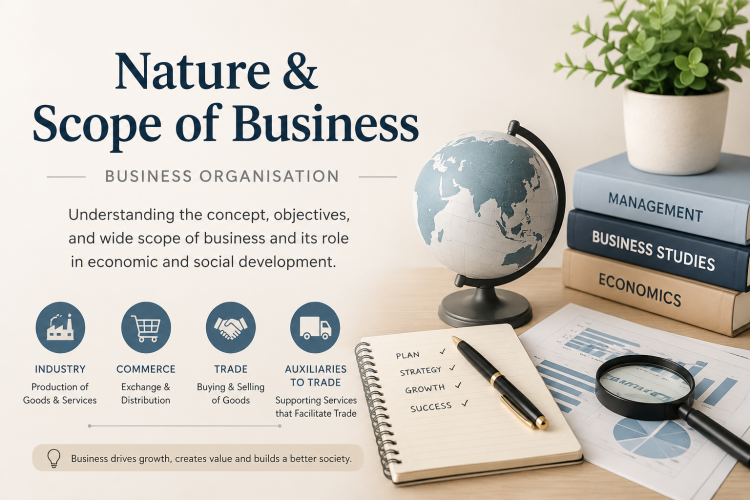
The scope of business refers to the wide range of activities that are involved in the production, distribution, and exchange of goods and services. It indicates the areas and operations covered by business enterprises to satisfy human wants and earn profits.
Business activities are not limited to manufacturing products. They also include trade, transportation, banking, insurance, warehousing, communication, advertising, and various support services that help goods reach consumers.
Therefore, the scope of business is very broad and encompasses Industry, Commerce, and Auxiliaries to Trade.
Business
│
├── Industry
│  ├── Primary Industry
│  ├── Secondary Industry
│  └── Tertiary Industry
│
└── Commerce
  ├── Trade
  │  ├── Internal Trade
  │  └── External Trade
  │
  └── Auxiliaries to Trade
    ├── Transportation
    ├── Warehousing
    ├── Banking
    ├── Insurance
    ├── Communication
    ├── Advertising
    └── Packaging
I. Industry
Industry refers to economic activities concerned with the production, extraction, processing, and manufacturing of goods.
It transforms raw materials into useful products.
Features of Industry
- Production-oriented activity
- Creates form utility
- Uses labor, capital, and technology
- Generates goods for consumption and trade
Types of Industry
1. Primary Industry
Primary industries obtain products directly from nature.
They form the foundation of all economic activities.
(a) Extractive Industry
Industries engaged in extracting natural resources.
Examples
- Coal mining
- Oil drilling
- Fishing
- Forestry
Importance
- Provides raw materials
- Supports manufacturing industries
- Generates employment
(b) Genetic Industry
Industries involved in breeding and multiplying plants and animals.
Examples
- Poultry farming
- Dairy farming
- Fish farming
- Plant nurseries
Importance
- Improves agricultural productivity
- Supplies food products
- Supports rural development
2. Secondary Industry
Secondary industries process raw materials into finished or semi-finished products.
(a) Manufacturing Industry
Converts raw materials into useful products.
Examples
- Textile Industry
- Automobile Industry
- Sugar Industry
- Cement Industry
Manufacturing Process Example
Cotton → Yarn → Cloth → Garments
Importance
- Adds value to raw materials
- Generates employment
- Promotes industrial growth
(b) Construction Industry
Engaged in the creation of infrastructure.
Examples
- Buildings
- Roads
- Bridges
- Dams
- Airports
Importance
- Supports economic development
- Creates public infrastructure
- Encourages investment
3. Tertiary Industry
Provides services that support production and distribution.
Examples
- Banking
- Insurance
- Transportation
- Tourism
- Education
Importance
- Facilitates industrial activities
- Improves efficiency
- Supports trade and commerce
II. Commerce
Commerce includes all activities involved in the distribution of goods and services from producers to consumers.
Commerce acts as a bridge between production and consumption.
Importance of Commerce
- Removes barriers in trade
- Creates place and time utility
- Expands markets
- Facilitates exchange
Components of Commerce
Commerce consists of:
- Trade
- Auxiliaries to Trade
A. Trade
Trade means buying and selling goods and services.
It helps transfer ownership of goods from producers to consumers.
Types of Trade
1. Internal (Home) Trade
Trade conducted within the geographical boundaries of a country.
(a) Wholesale Trade
Buying goods in large quantities and selling them to retailers.
Example
A wholesaler purchasing sugar from factories and supplying it to retailers.
Functions
- Bulk purchasing
- Storage
- Distribution
(b) Retail Trade
Selling goods directly to final consumers.
Example
Grocery shops, supermarkets, and online stores.
Functions
- Provides goods in small quantities
- Offers customer services
- Connects consumers with producers
2. External (Foreign) Trade
Trade conducted between two or more countries.
(a) Import Trade
Purchasing goods from foreign countries.
Example
India importing crude oil from other countries.
(b) Export Trade
Selling goods to foreign countries.
Example
India exporting tea, textiles, and software services.
(c) Entrepot Trade
Importing goods and re-exporting them to another country.
Example
A country importing electronic goods and re-exporting them without significant processing.
B. Auxiliaries to Trade
Auxiliaries to trade are services that assist and facilitate trade.
Without these services, smooth distribution of goods would be difficult.
1. Transportation
Transportation involves the movement of goods and people from one place to another.
Modes
- Roadways
- Railways
- Airways
- Waterways
Importance
- Creates place utility
- Expands market areas
- Facilitates national and international trade
Example
Transporting vegetables from farms to city markets.
2. Warehousing
Warehousing refers to the storage of goods until they are required.
Importance
- Creates time utility
- Prevents shortage
- Protects goods
Example
Storing wheat in government warehouses for future distribution.
3. Banking
Banks provide financial services necessary for business operations.
Functions
- Accepting deposits
- Granting loans
- Fund transfers
- Credit creation
Importance
- Provides working capital
- Facilitates business expansion
- Supports economic growth
Example
A business obtaining a loan to purchase machinery.
4. Insurance
Insurance protects businesses against various risks.
Types
- Life Insurance
- Fire Insurance
- Marine Insurance
- Motor Insurance
Importance
- Reduces uncertainty
- Protects assets
- Encourages investment
Example
A factory insured against fire damage.
5. Communication
Communication helps exchange information between producers, traders, and consumers.
Means
- Telephone
- Internet
- Mobile Applications
Importance
- Facilitates decision-making
- Speeds up business operations
- Improves coordination
Example
An online retailer receiving customer orders through a website.
6. Advertising
Advertising informs consumers about products and services.
Objectives
- Increase awareness
- Promote sales
- Build brand image
Example
Television advertisements for new products.
Importance
- Educates consumers
- Increases market demand
- Enhances competition
7. Packaging
Packaging refers to covering and protecting products.
Functions
- Protection
- Identification
- Promotion
- Convenience
Example
Packaged biscuits sold in sealed wrappers.
Importance
- Prevents damage
- Attracts customers
- Facilitates transportation
Modern Scope of Business
In today's economy, the scope of business has expanded beyond traditional trade and industry.
Modern business includes:
E-Commerce
Buying and selling through online platforms.
Examples: Amazon, Flipkart
Information Technology Services
Software development and digital solutions.
Financial Services
Digital banking, fintech, and investment services.
Tourism and Hospitality
Hotels, travel agencies, and tourism services.
Consulting Services
Professional advisory services for businesses.
Education and Training
Online learning and skill development platforms.
Importance of Scope of Business
1. Economic Development
Business promotes industrial and commercial growth.
2. Employment Generation
Creates direct and indirect job opportunities.
3. Wealth Creation
Contributes to national income and prosperity.
4. Better Standard of Living
Provides goods and services that improve quality of life.
5. International Relations
Encourages global trade and cooperation.
6. Resource Utilization
Ensures efficient use of natural and human resources.
Conclusion
Business is a dynamic economic activity involving the production, distribution, and exchange of goods and services for profit and customer satisfaction. Its nature is characterized by regular economic activities, profit motive, risk, and creation of utility. The scope of business is extensive, covering industry, commerce, trade, and auxiliary services such as banking, insurance, transportation, communication, warehousing, and advertising. In the modern world, business is not only a means of earning profit but also an instrument for economic development, social welfare, employment generation, and improvement of living standards. Thus, business occupies a central position in the economic and social structure of every nation.
What's Your Reaction?